
Our Short List of 3
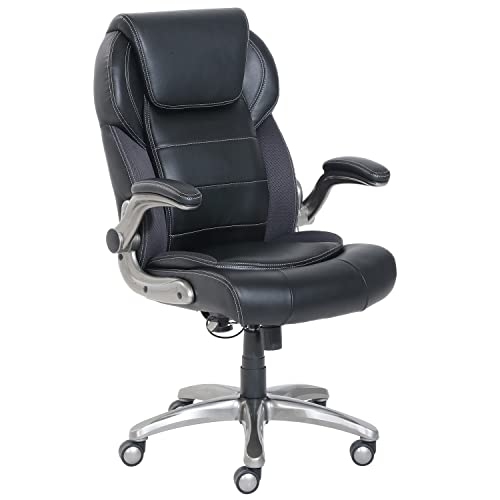
- Best for: Everyday desk work where you want lumbar support without fiddling with settings.
- Bonded leather upholstery with segmented foam padding
- Adaptive lumbar support that adjusts as you move
- Flip-up armrests
- Adjustable seat height and tilt

- Best for: Narrow desks and tight corners where a 19.3-inch-wide chair still needs armrests.
- Bonded leather upholstery with foam fill
- Three-stage backrest covering upper back, lower back, and lumbar
- Double-layer seat cushion
- Flip-up padded armrests with adjustable angle
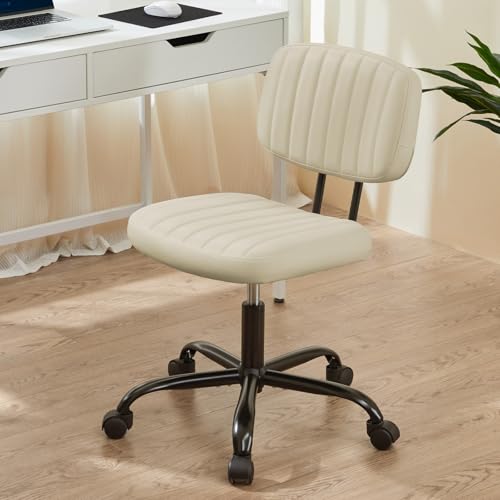
- Best for: Very small desks, vanities, and shared rooms where the chair must disappear under the desk.
- PU leather upholstery over high-density foam cushion on seat and backrest
- U-shaped lumbar support system
- Armless design with 360-degree swivel
- Seat height adjustable from 17.71 to 21.45 inches
All 4 Picks at a Glance
| Product | Specs | Action |
|---|---|---|
| Amazon Basics Ergonomic High-Back Office Chair |
| Check price on Amazon |
| Amseatec LY-5192 Mid-Back Office Chair |
| Check price on Amazon |
| Sweetcrispy Small Office Desk Chair |
| Check price on Amazon |
 Flash Furniture LeatherSoft Mid-Back Office Chair |
| Check price on Amazon |
Key takeaways
- Five padded ergonomic office chairs sized for compact desks, with flip-up arms, adjustable lumbar support and real dimensions to check before you buy.
What's inside
As an Amazon Associate I earn from qualifying purchases. This post may contain affiliate links at no extra cost to you.
Choosing an ergonomic upholstered office chair for a compact desk is a decision about footprint and fit, not about how plush the cushion looks. A chair that is too wide will crowd the desk edge, arms that cannot move out of the way will keep the chair from sliding underneath, and a seat that is too deep will leave your feet dangling while your lower back loses contact with the backrest. The right chair earns its place by matching your desk clearance, your leg length, and the hours you sit.
This guide is for people setting up a small home office, a bedroom workstation, or a shared apartment desk where every inch matters. It covers five upholstered chairs with padded seats and backs, each chosen from its Amazon listing for a real dimension, adjustment, or space-saving feature. Measure your desk height, knee clearance, and the floor space behind you before you pick one, and compare those numbers with the specs listed below.
Quick Picks
As an Amazon Associate we earn from qualifying purchases.
| Product | Best for | Key spec from title |
|---|---|---|
| COLAMY High Back Executive Office Chair | Long workdays at a small desk with full back coverage | Inflatable lumbar support and flip-up arms |
| Amazon Basics Ergonomic High-Back Office Chair | A straightforward leather chair with adaptive lumbar support | Flip-up arms and adjustable lumbar support |
| Amseatec LY-5192 Mid-Back Office Chair | The narrowest footprint among the armed chairs here | 19.3-inch width with flip-up padded arms |
| Sweetcrispy Small Office Desk Chair | Sliding fully under a compact desk or vanity | Armless frame, 18.11 inches wide |
| Flash Furniture LeatherSoft Mid-Back Office Chair | A low mid-back profile that tucks under a desk | 25 by 25 inch footprint |
How to Choose
Measure the chair against your desk, not the room
Begin with three numbers from your own setup: the height from the floor to the underside of the desk, the depth from the desk edge to the wall behind you, and the width of the leg space. Then compare the chair’s listed width, depth, and lowest seat height against those figures. A chair with flip-up arms can slide under a desk even when its base is wide, while an armless chair needs no arm clearance at all. If the seat height at its lowest setting still lifts your knees above your hips, the chair is too tall for the desk, no matter how comfortable the cushion feels.
Check seat depth before you check cushion thickness
Seat depth decides whether your back reaches the backrest while your feet stay flat on the floor. A seat deeper than your thigh length pushes you forward and leaves a gap behind your lower back, which is exactly where an ergonomic chair is supposed to support you. The chairs in this guide list seat depths from 17.51 inches to 21.5 inches, a spread wide enough to matter for shorter and taller sitters alike. Sit with your back flat against the backrest and confirm that two or three fingers fit between the seat edge and the back of your knee.
Look for lumbar support you can actually adjust
Fixed lumbar padding helps only if its curve lands in the right spot for your spine, and that spot moves with your height and posture. An inflatable lumbar airbag, an adaptive lumbar panel, or a multi-zone backrest lets you change the support instead of accepting a shape that was designed for someone else. Pay attention to whether the listing describes the lumbar feature as adjustable, because several upholstered chairs in this category offer padding without any way to move it. If you already know you need firm lower-back support, adjustable lumbar belongs near the top of your list.
Weigh the upholstery against your room and your habits
Bonded leather and PU leather wipe clean and look tidy in a small room, yet they can feel warm during long sessions and may show wear at the edges over time. Fabric breathes better and grips slightly when you shift position, though it absorbs spills and dust more readily. Foam density matters too: a high-density foam cushion holds its shape through months of daily use, while softer foam compresses and leaves you sitting lower than the listing promised. Consider who else uses the chair, whether pets share the room, and how often you are willing to clean it.
The 5 Best Options
COLAMY High Back Executive Office Chair
This high-back chair suits someone who works long hours at a compact desk and wants full coverage from headrest to seat without giving up floor space. Its padded arms flip up ninety degrees, so the chair slides under the desk when the workday ends, and the inflatable lumbar airbag lets you pump the lower-back support to the firmness that fits your spine. A built-in spring layer under the cushion adds the kind of give you would expect from a sofa seat, and the back tilts from ninety to one hundred ten degrees with a tension knob underneath.
Specs
- Bonded leather upholstery with a padded headrest
- Inflatable lumbar airbag, adjustable by pressing the airbag
- Flip-up padded armrests with a ninety-degree rotation
- Seat height adjustable from 18.6 to 22.4 inches
- Seat depth of 21.1 inches
- Back tilt range of 90 to 110 degrees with tilt tension control
- Product dimensions of 29.9 inches deep by 26 inches wide by 48 inches high
- Maximum weight recommendation of 275 pounds
- 360-degree swivel nylon casters
Best for: Long sessions at a small desk where full back and neck coverage matters.
Watch out for: The 26-inch width and 29.9-inch depth make it the largest chair in this guide, so confirm your floor space before ordering.
Amazon Basics Ergonomic High-Back Office Chair
- Best for: Everyday desk work where you want lumbar support without fiddling with settings.
- Bonded leather upholstery with segmented foam padding
- Adaptive lumbar support that adjusts as you move
- Flip-up armrests
- Adjustable seat height and tilt
Everyday desk work where you want lumbar support without fiddling with settings.
The listing gives no maximum weight figure, so heavier users should confirm the limit with the seller before buying.
This chair fits a buyer who wants a plain, dependable leather office chair with ergonomic features and no learning curve. Segmented padding runs through the seat and back, and the lumbar support adapts as you move, which means you do not have to stop and adjust a separate pad during the day. Flip-up arms let the chair tuck under a desk, and the height and tilt controls sit where your hand expects them. A five-point metal base with oversized casters keeps the chair steady when you roll between a desk and a side table.
Watch out for: The listing gives no maximum weight figure, so heavier users should confirm the limit with the seller before buying.
Amseatec LY-5192 Mid-Back Office Chair
- Best for: Narrow desks and tight corners where a 19.3-inch-wide chair still needs armrests.
- Bonded leather upholstery with foam fill
- Three-stage backrest covering upper back, lower back, and lumbar
- Double-layer seat cushion
- Flip-up padded armrests with adjustable angle
Narrow desks and tight corners where a 19.3-inch-wide chair still needs armrests.
The mid-back design offers no headrest, so it suits shorter sessions or sitters who do not lean back to rest their neck.
At 19.3 inches wide, this mid-back chair is the narrowest armed option in this guide, and that slim profile is its main argument for a compact desk. The backrest is built in three zones for the upper back, lower back, and lumbar area, while the seat uses a double-layer cushion that stays soft on top and firm underneath. Padded arms flip up and adjust in angle, so you can slide the chair under the desk or sit cross-legged, and the tilt locks upright or rocks to one hundred fifteen degrees with a tension knob.
Watch out for: The mid-back design offers no headrest, so it suits shorter sessions or sitters who do not lean back to rest their neck.
Sweetcrispy Small Office Desk Chair
- Best for: Very small desks, vanities, and shared rooms where the chair must disappear under the desk.
- PU leather upholstery over high-density foam cushion on seat and backrest
- U-shaped lumbar support system
- Armless design with 360-degree swivel
- Seat height adjustable from 17.71 to 21.45 inches
Very small desks, vanities, and shared rooms where the chair must disappear under the desk.
There are no armrests at all, so anyone who rests their forearms while typing will miss them.
This armless chair is the simplest answer to a desk with almost no spare room, because without arms there is nothing to collide with the desk edge or the wall beside you. The seat and backrest carry high-density foam under a PU leather cover with a vertical grain pattern meant to let air circulate, and a U-shaped lumbar support sits behind your lower back. It swivels a full circle on a metal frame, adjusts from 17.71 to 21.45 inches in seat height, and at 18.11 inches wide it fits under desks and vanities that wider chairs cannot approach.
Watch out for: There are no armrests at all, so anyone who rests their forearms while typing will miss them.
Flash Furniture LeatherSoft Mid-Back Office Chair
- Best for: A dorm room or small home office where a low mid-back chair needs to tuck away neatly.
- LeatherSoft upholstery, a blend of leather and polyurethane
- Thick padded seat with a waterfall front edge
- Mid-back design with built-in armrests
- Tilt tension knob and tilt lock mechanism
A dorm room or small home office where a low mid-back chair needs to tuck away neatly.
The listing shows no adjustable lumbar support, and the armrests are fixed, so check both against your needs before buying.
This mid-back chair works for a buyer who wants a classic leather-look office chair with a small square footprint and a low profile. Its LeatherSoft upholstery blends leather and polyurethane, and the thick padded seat has a waterfall front edge that eases pressure behind the knees during long sits. A tilt tension knob and tilt lock let you rock gently or hold the chair upright, and the whole chair occupies a 25 by 25 inch square, which fits under dorm and home-office desks that larger executive chairs would crowd.
Watch out for: The listing shows no adjustable lumbar support, and the armrests are fixed, so check both against your needs before buying.
Which One Fits Your Situation
A desk in a bedroom corner with barely any floor space
Pick the Sweetcrispy chair. Its armless frame is only 18.11 inches wide and 16.33 inches deep, so it slides under a small desk and leaves the walkway clear when you stand up. The Amseatec is the fallback if you want arms, since its 19.3-inch width is still narrow enough for most bedroom desks.
Long workdays with a sore lower back
Pick the COLAMY chair. Its inflatable lumbar airbag is the only lumbar feature in this guide that you can pump to an exact firmness, and the high back with a padded headrest supports your neck during breaks. The Amazon Basics chair is the simpler alternative, with lumbar support that adapts as you move.
A shared desk used by more than one person
Pick the Amseatec LY-5192. Its 300-pound capacity and BIFMA certified components handle different body types, the flip-up arms adapt to each sitter, and the 18.1-inch seat depth suits a wider range of leg lengths than the deeper chairs here. The Sweetcrispy is a good second chair for a shared room because it stores under the desk.
A tidy, professional look in a small home office
Pick the Flash Furniture LeatherSoft chair. Its mid-back profile and 25 by 25 inch footprint keep the room looking uncluttered, and the LeatherSoft upholstery wipes clean between uses. If you want the same polished look with more back coverage, the COLAMY in black gives you a high-back silhouette with flip-up arms.
Common Mistakes
- Buying by cushion softness alone and ignoring seat depth, which decides whether your back actually reaches the backrest.
- Forgetting to measure the clearance under the desk, then discovering the armrests keep the chair from sliding underneath.
- Choosing a chair wider than the leg space, so you sit angled toward the keyboard instead of square to the screen.
- Assuming every upholstered chair has adjustable lumbar support, when many listings only describe fixed padding.
- Skipping the maximum weight figure, which tells you more about the frame and gas lift than any photo can.
Frequently Asked Questions
How do I know if an office chair will fit under my desk?
Measure from the floor to the underside of your desk, then compare that number with the chair’s lowest seat height plus the armrest height. Chairs with flip-up arms or no arms at all slide under far more easily, because the arms are usually what catches. Also check the chair’s width against the clear space between the desk legs.
Is a padded back better than a mesh back for a compact desk?
A padded back gives you a solid surface to lean against and often includes built-in lumbar shaping, which suits long sessions in a small room. Mesh breathes better in warm rooms but offers less cushioning. For a compact desk, the deciding factor is usually the chair’s depth and arm design rather than the back material alone.
What seat depth works for a shorter person?
A seat depth around 17 to 18 inches usually lets a shorter sitter place their back flat against the backrest with feet on the floor. Deeper seats around 21 inches suit taller legs. The Sweetcrispy at 17.51 inches and the Amseatec at 18.1 inches are the shallowest options in this guide.
Do flip-up arms really help in a small office?
Yes, because they remove the widest part of the chair when you are not using them. You can push the chair fully under the desk at the end of the day, which frees floor space and keeps the room tidy. They also let you sit sideways or cross-legged when you want a change of posture during a break.
Related guides
More from Amazon
Programs that pair well with the guide above. Offers and eligibility are set by Amazon and may change.
Free shipping on eligible items, Prime Video and more. Eligible new members can start with a free trial.
Start a Prime free trialAd-free music streaming. Eligible new subscribers can start with a free trial.
Try Music Unlimited freeA Prime membership for ages 18-24 with a trial period. Eligibility is set by Amazon.
See Prime for Young AdultsAudiobooks and podcasts to listen to on the go. Eligible new members can start with a free trial.
Try Audible freeAs an Amazon Associate we earn from qualifying purchases.










Write Your Review
No reviews yet. Be the first to share your experience!