
Key takeaways
- Four ergonomic upholstered office chairs that drop low enough for short adults to sit with feet flat, with adjustable seat depth and real lumbar support.
What's inside
As an Amazon Associate I earn from qualifying purchases. This post may contain affiliate links at no extra cost to you.
Choosing an office chair as a short adult is a decision about fit, not features. Most task chairs are built around an average frame, so the seat bottoms out above the floor, the front edge presses into the back of your knees, and the lumbar curve lands above your lower back. The result is a workday spent perched on the edge of the seat or dangling your feet, whatever the spec sheet promises.
This guide is for shorter adults who want a padded, upholstered chair rather than a mesh seat, and who need the seat to drop low enough for both feet to rest flat. Each chair below was picked from its Amazon listing for a low minimum seat height, a seat depth that can be shortened, and a backrest that supports a smaller frame. Check the seat numbers against your leg length before ordering, because a single inch at the low end of the range decides whether the chair fits you or fights you.
Quick Picks
As an Amazon Associate we earn from qualifying purchases.
| Product | Best for | Key spec from title |
|---|---|---|
| Steelcase Gesture Low-Height Fabric Chair | The lowest seat in this guide | Seat height 14.5 to 18.25 inches |
| Steelcase Leap V2 Fabric Office Chair | The most lumbar control | Seat height 15.5 to 20.5 inches |
| Steelcase Amia Office Chair | All-day cushioned comfort | Seat height 16 to 21 inches |
| Humanscale Freedom Task Chair | Simple recline with no levers to learn | Seat height 16.125 to 20.25 inches |
How to Choose
Minimum seat height first
Begin with the lowest seat height on the listing, because it is the one number that decides whether your feet reach the floor. At around five feet tall, the back of the knee sits roughly 15 to 17 inches above the floor, so a chair that bottoms out at 18 or 19 inches leaves your feet dangling even at its lowest setting. Look for a minimum of 17 inches or less, and compare that figure with your own knee height measured while wearing your work shoes. A chair that drops to 16 inches or below gives most short adults room to spare, while a chair that only reaches 18 inches may still work if you pair it with a footrest.
Seat depth and the front edge
Seat depth decides whether you can sit all the way back against the backrest without the front edge cutting into the backs of your knees. Shorter adults usually need a seat depth of 17 inches or less, or a slider that pulls the seat pan forward and back. Measure from the back of your hip to the back of your knee while seated, then subtract about two inches for clearance. If the listing gives only one depth figure, treat it as fixed and check it against your measurement. A chair with a sliding seat pan is the safer buy when two people of different heights share one desk, because each of you can set the depth to your legs.
Lumbar support that lands low enough
Lumbar support only helps when the curve meets your lower back, and on a chair built for taller people it often sits too high for a short adult. Look for lumbar support that moves up and down, or a backrest that slides on its own track, so you can drop the support to where your spine curves. A fixed lumbar pad can still work if the backrest is short, because a shorter back puts the curve closer to your waist. Sit in the chair, or check the listing dimensions, and confirm the lumbar zone falls in the lower third of the backrest, not the middle. If it presses your mid-back instead, the chair will feel wrong within an hour.
Armrests and backrest that fit a smaller frame
Armrests and backrests are sized for average shoulders, so on a short adult they often sit too wide or too tall to be useful. Arms that adjust in height, width, and pivot let you bring the pads in close and drop them low enough that your shoulders stay relaxed while you type. If the arms only move up and down, check their lowest height against your elbow height when seated. A backrest that is too tall can also push your head forward, so a mid-back design or a backrest with its own height adjustment suits smaller frames better than a tall executive back. Flip-up arms are a bonus when you want to tuck the chair fully under the desk.
The 4 Best Options
Steelcase Gesture Low-Height Fabric Chair

The low-height Gesture is the chair in this guide that drops the furthest, with a seat range that begins at 14.5 inches. That low cylinder is the whole point for short adults: you can sit with your thighs level and both feet flat without a footrest under the desk. The seat and back are wrapped in Connect fabric and move as one synchronized system, so the back follows you as you lean. Seat depth slides, the arms adjust in every direction, and a four-position recline lock holds the back where you set it. It is a heavy chair that ships ready to assemble, so plan for help unpacking it.
Specs
- Seat height: Low Height Range, 14.5 to 18.25 inches
- Upholstery: Connect fabric, polyester
- Back: Wrapped back and seat
- Seat depth: 18.25 inches, with adjustable seat depth
- Arms: Fully adjustable
- Recline: Tension adjustment and 4-position recline lock
- Casters: Hard floor casters
- Dimensions: 28.75 x 28.75 x 40.25 inches
- Weight: 78 pounds
- Warranty: 12-year manufacturer warranty
Best for: Short adults who want the lowest seat in this guide and sit on hard floors.
Watch out for: The listed seat depth of 18.25 inches is the maximum, so slide the seat pan back and confirm the shallowest setting fits your legs; lumbar adjustment is not listed on this build, so check the exact configuration before ordering.
Steelcase Leap V2 Fabric Office Chair
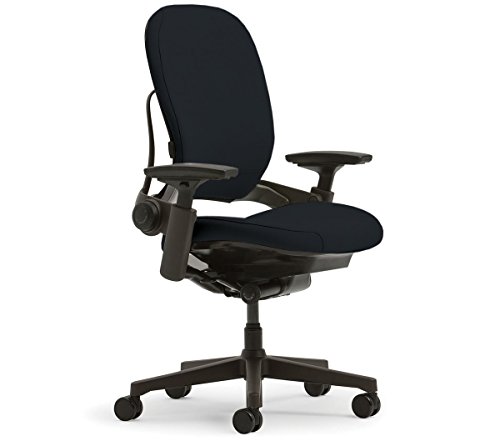
The Leap V2 is the pick for short adults who want the most control over their lower back. Its seat drops to 15.5 inches, and the seat pan slides from 15.75 to 18.75 inches deep, so you can pull the front edge back from your knees and sit against the backrest. The lumbar support moves up and down and has a firmness dial, so the curve lands where your lower back is. LiveBack flexes with your spine as you move, and the Natural Glide system keeps the seat moving with you as you recline. It is a firm seat, so give it a few weeks before judging the comfort.
Specs
- Seat height: 15.5 to 20.5 inches
- Seat depth: 15.75 to 18.75 inches, with seat slider
- Weight capacity: 400 pounds
- Back: LiveBack with height-adjustable lumbar support and firmness dial
- Seat: Foam with fabric upholstery
- Arms: 4D adjustable arms
- Recline: Natural Glide with recline tension
- Warranty: 12-year manufacturer warranty
Best for: Short adults who want the most adjustable lumbar support and seat depth.
Watch out for: The seat feels firm at first, and the listing does not include a headrest, so check the exact configuration if you want one.
Steelcase Amia Office Chair
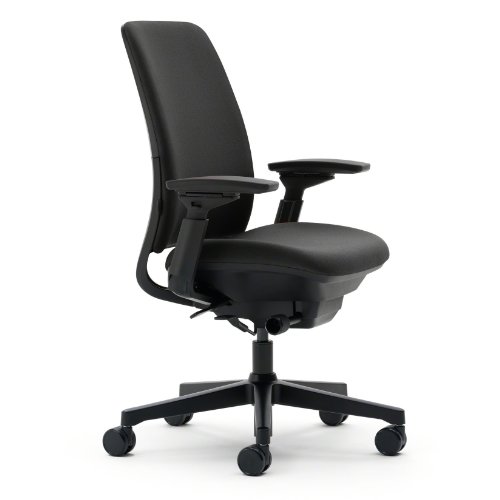
The Amia is the comfortable middle of this guide: a thick foam seat, a fabric back, and a lumbar system hidden inside the backrest. LiveLumbar flexes as you move, so the support follows your spine through the day instead of holding one fixed shape. The seat drops to 16 inches and the depth slides from 15.5 to 18.5 inches, which covers most short adults, and the arms adjust in height, width, depth, and pivot. Flexible front seat edges take pressure off the backs of your knees. It is the chair to choose when you want cushioning first and a long list of levers second.
Specs
- Seat height: 16 to 21 inches
- Seat depth: 15.5 to 18.5 inches, with seat slider
- Weight capacity: 300 pounds
- Back: Upholstered back with hidden LiveLumbar system
- Seat: Foam with Buzz2 polyester fabric, flexible front edges
- Arms: 4D adjustable arms, height, width, depth, and pivot
- Recline: Full recline with upright lock and tilt tension
- Dimensions: 24.75 x 26.63 x 42.5 inches
- Weight: 54.5 pounds
- Warranty: 12-year manufacturer warranty
Best for: Short adults who want a thick cushioned seat and lumbar support that moves with them.
Watch out for: The 16-inch minimum seat height is the highest in this guide, so measure your knee height first if you are under five feet tall.
Humanscale Freedom Task Chair

The Freedom takes a different approach: instead of levers and knobs, a weight-sensitive mechanism sets the recline resistance for you as you lean back. The seat drops to about 16.1 inches on the standard cylinder, and the chair is sized for users from five feet tall, with a sculpted foam seat and a foam backrest covered in fabric. Seat depth adjusts, the backrest moves independently, and the arms travel with the backrest so they stay in the same relation to your body. It is the simplest chair here to live with, because there is almost nothing to set up once the height is right.
Specs
- Seat height: 16.125 to 20.25 inches, standard cylinder
- Seat depth: 17.40 to 19.85 inches
- Weight capacity: 300 pounds
- Back: Foam-cushioned backrest, fabric upholstery
- Recline: Weight-sensitive, self-locking recline, 22 degrees of recline plus 7 degrees of backrest tilt
- Arms: Synchronous arms attached to the backrest, height adjustable
- Frame: Aluminum frame
- Weight: 38 pounds with arms
- Warranty: 15-year warranty on seating components, 5 years on upholstery and cushions
Best for: Short adults who want recline that adjusts itself and dislike fiddling with levers.
Watch out for: The seat depth begins at 17.40 inches, which is deep for very short legs, so slide it to the shallowest setting and sit against the backrest before deciding.
Which One Fits Your Situation
You are around five feet tall and your feet dangle on most chairs
The Gesture low-height build is the clearest answer here, because its seat drops to 14.5 inches, lower than anything else in this guide. Set the seat so your thighs are level, slide the seat pan back until there is a gap behind your knees, and drop the arms to desk height. If your floors are hard, this build already comes with hard floor casters, so you will not need to swap them.
You sit for long workdays and want the most lumbar control
Choose the Leap V2. Its lumbar support moves up and down and has a firmness dial, so you can place the curve exactly where your lower back needs it and change the pressure through the day. The seat depth slider and the 15.5-inch minimum height keep the fit right for shorter legs, and the LiveBack flexes as you shift. Give the firm seat a few weeks before deciding whether the cushioning suits you.
You want cushioning first and a simple chair second
Pick the Amia. Its thick foam seat and hidden LiveLumbar system give you comfort without a row of dials to learn, and the flexible seat edges are kind to the backs of your knees. The 16-inch minimum height suits most short adults, though very petite sitters should measure first. The arms adjust in every direction, so you can still fine-tune the fit once the chair is under your desk.
You dislike levers and want the chair to adjust itself
Take the Freedom. Its weight-sensitive recline sets its own resistance as you lean, and the arms move with the backrest, so there is almost nothing to learn after you set the seat height. Check the seat depth first, because it begins at 17.40 inches and runs deep for very short legs. If the shallowest setting still leaves the front edge pressing your knees, the Leap V2 or the Amia will fit better.
Common Mistakes
- Buying by looks and skipping the minimum seat height on the listing.
- Choosing a seat depth that leaves no gap behind your knees when you sit back.
- Assuming lumbar support will land in the right place without checking whether it moves up and down.
- Picking arms that only move up and down, then finding they sit too wide for narrow shoulders.
- Ordering the wrong caster type for your floor and only noticing when the chair rolls poorly.
Frequently Asked Questions
What seat height should a short adult look for in an office chair?
Look for a chair whose seat drops to 17 inches or less. At around five feet tall, the back of the knee sits roughly 15 to 17 inches above the floor, so a chair that bottoms out at 18 or 19 inches leaves your feet dangling. Measure your knee height in your usual work shoes, then compare it with the lowest seat height on the listing before ordering.
Does seat depth matter as much as seat height?
Yes, and for some short adults it matters more. A seat that is too deep pushes you forward off the backrest or presses the front edge into the backs of your knees, which strains your legs even when the height is right. Look for a depth of 17 inches or less, or a slider that shortens the seat pan, and leave about two inches of clearance behind your knees.
Can a footrest fix a chair that is too tall?
A footrest helps, but it is a workaround rather than a fix. It supports your feet and takes pressure off your thighs, yet it does nothing about a seat that is too deep or a lumbar curve that sits too high. Use a footrest as a short-term fix or alongside a chair that already drops low, and treat a chair with the right minimum seat height as the long-term answer.
Are upholstered chairs better than mesh chairs for short adults?
Neither type is better by itself; the fit numbers decide. Upholstered chairs give you a padded seat and back that feel warm and soft, which many people prefer for long days, while mesh chairs breathe better in warm rooms. What matters for a short adult is the minimum seat height, the seat depth, and whether the lumbar support can move low enough, so judge any chair by those numbers first.
Related guides
- Best Laptops to Play Roblox: From Budget Integrated Graphics to Dedicated GPUs
- Best Laptops for Zoom Teaching: Clear Video, Reliable Audio and All-Day Class Power
- Best Laptops for Video Editing and Music Production: Power, Screen and Storage
- Best Laptops for Network Engineers: Ethernet, RAM for Labs and Ports That Matter
More from Amazon
Programs that pair well with the guide above. Offers and eligibility are set by Amazon and may change.
Free shipping on eligible items, Prime Video and more. Eligible new members can start with a free trial.
Start a Prime free trialAd-free music streaming. Eligible new subscribers can start with a free trial.
Try Music Unlimited freeA Prime membership for ages 18-24 with a trial period. Eligibility is set by Amazon.
See Prime for Young AdultsAudiobooks and podcasts to listen to on the go. Eligible new members can start with a free trial.
Try Audible freeAs an Amazon Associate we earn from qualifying purchases.
Write Your Review
No reviews yet. Be the first to share your experience!