
Key takeaways
- Compare the best educational toys for kids for birthdays, homeschool and screen-free play, from magnetic tiles to circuits, with age and safety checks.
What's inside
As an Amazon Associate I earn from qualifying purchases. This post may contain affiliate links at no extra cost to you.
The hard part of buying an educational toy for kids in general is not finding something labelled learning. Shelves are full of those. The real decision is matching a toy to a situation: a birthday when you barely know the child, a homeschool table that needs practical work, or a household trying to cut passive screen time without starting an argument.
So this guide is organised by need rather than by a single birthday age. It covers gift buyers, home educators, and families with siblings of different ages who need to play together. Each recommendation comes from its Amazon listing, with the stated age range, contents, and requirements checked before it earned a place. Where a listing sets a minimum age, this guide treats that limit as final, whatever the occasion.
Quick Picks
As an Amazon Associate we earn from qualifying purchases.
| Product | Best for | Key spec from title |
|---|---|---|
| PicassoTiles 100 Piece Set | Siblings building together at home | 100pcs Magnet Building Tiles |
| Osmo Genius Starter Kit for iPad | Active learning on a tablet you already own | 5 Educational Learning Games, Ages 6-10 |
| ThinkFun Gravity Maze | Screen-free strategy for older kids | Falling Marble Logic Game |
| Snap Circuits Jr. SC-100 | A first electronics kit for homeschool projects | Over 100 Projects, 28 Parts |
| Educational Insights Kanoodle | Travel and quiet-time puzzles for mixed ages | Original 3D Brain Teaser Puzzle, Ages 7+ |
How to Choose
Buy for the Situation, Not a Generic Label
Start by naming the job the toy has to do. A birthday gift for a child you do not know well should be self-contained, quick to explain, and forgiving of different skill levels, which is why a portable puzzle or a building set travels better than a kit tied to one device. A homeschool purchase has the opposite priority: it should connect to topics you revisit over weeks, like circuits or maths, and include a manual or levels that structure repeat use. The same budget buys very different value depending on which job you choose first.
Plan for Siblings of Different Ages Sharing
Mixed-age play fails when the youngest child can only watch. Look for open-ended materials where a younger sibling can build something simple beside an older child’s ambitious project, or for leveled challenges where each child picks a card at their own difficulty. Magnetic tiles handle the first pattern well. Gravity Maze and Kanoodle handle the second, though both carry manufacturer minimum ages that younger siblings must respect. Taking turns as challenge setter, with an older child placing pieces for a younger player’s card within the stated age range, keeps everyone involved.
Decide Your Screen Boundary Before Shopping
Screen-free is a spectrum in practice. Four picks in this guide need no screen at all. One, the Osmo Genius Starter Kit, deliberately uses an iPad, turning it into an active surface where children move physical tiles, numbers, and letters in front of the camera. Neither approach is automatically better. What matters is deciding in advance: if the goal is replacing passive viewing, an active tablet kit may help; if the goal is a device-free afternoon, choose the puzzles, tiles, or circuits and skip the argument later.
Respect the Age on the Box, Every Time
General gift guides often blur age guidance, and that is where purchases go wrong. In this list the stated ranges run from three years and up for the magnetic tiles to eight years and up for Gravity Maze and Snap Circuits Jr. Those minimums reflect small parts, difficulty, or both, and this guide never suggests using a product below its listed age. When buying for a household rather than one child, also think about storage: a toy rated for an older child still needs keeping out of reach of a toddler between sessions.
The 5 Best Options
PicassoTiles 100 Piece Set

A hundred magnetic tiles change what a family can build. Instead of negotiating over a handful of squares, siblings can each start a structure and then join them into one street, zoo, or castle, which removes the most common cause of building-set arguments. The clear coloured pieces form flat patterns and three-dimensional shapes, so the same box serves a child practising shape recognition and an older one testing which walls support a roof. Cleanup is quick because the pieces stack, and the set scales if relatives want to add more later.
Specs
- Brand: PicassoTiles
- Model number: PT100
- Manufacturer recommended age: 3 years and up
- Number of pieces: 100 magnetic building tiles
- Play described on the listing as suitable for one player or groups, for ages 3 and up
- Educational focus listed: creativity, shape building, and 2D and 3D construction play
Best for: A birthday gift or family set that siblings of different ages can genuinely share.
Watch out for: This is a magnetic toy, so follow the listing age of 3 years and up and store tiles away from much younger children.
ASIN: B00AU56C5W
Osmo Genius Starter Kit for iPad

Osmo answers a specific household problem: a tablet already exists, and you would rather it hosted active learning than another video. Physical tangram pieces, number tiles, and word tiles sit on the table while the iPad camera reads each move and responds, covering maths, spelling, drawing, and early physics across five games. Difficulty runs from beginner to expert within the games, which helps one kit serve a wider span of primary-school ages. It suits homeschool afternoons especially well, because sessions have clear subjects without needing printed worksheets.
Specs
- Brand: Osmo
- Item model number: 901-00011
- Title states ages 6-10; manufacturer recommended age listed as 5 to 10 years
- Included: Osmo Base and reflector for iPad, tangram pieces, numbers tiles, words tiles, stackable storage, and 5 game apps: Numbers, Tangram, Words, Newton, and Masterpiece
- iPad not included; both the base and an iPad are required for play
- No WiFi necessary for game play, per the listing
- Product dimensions: 2.75 x 12 x 9.6 inches; item weight 2.2 pounds
Best for: Families who already own a compatible iPad and want screen time that involves hands and thinking.
Watch out for: Check the listing compatibility notes carefully before buying, because several iPad generations are excluded and some models need the 2021 reflector.
ASIN: B07NHS4D4T
ThinkFun Gravity Maze

Gravity Maze gives older kids a building toy that behaves like a logic exam in disguise. A challenge card shows where towers start and where the marble must finish, and the player arranges the remaining towers so gravity carries the marble through the right path. Sixty cards move from beginner to expert, so progress is visible and a child who breezes through early cards still meets resistance later. It plays solo, needs no batteries, and resets fast, which makes it a dependable quiet-time option for a child who has outgrown simpler puzzles.
Specs
- Brand: ThinkFun
- Model number: 44001006
- Age range listed: 8 and up; manufacturer minimum age 96 months
- Included components: 1 target piece, 3 marbles, 60 challenge cards from beginner to expert, 9 towers, game grid
- Number of players: single player
- Power: no batteries required
- Material: paper and plastic; item weight 1.1 pounds
Best for: A screen-free strategy gift for an older child who enjoys building and solving alone.
Watch out for: Do not buy this for a child under eight; the listing minimum age is there for difficulty and for the small marbles included.
ASIN: B00IUAAK2A
Snap Circuits Jr. SC-100

For homeschool families, this kit turns electricity from a diagram into something a child can switch on. Numbered, colour-coded parts snap onto a grid without soldering, and the full-colour manual orders more than a hundred projects from a simple light and switch toward fans, alarms, and sound-activated circuits. Because each project builds on earlier ones, it works as a loose curriculum across several weeks rather than a single afternoon of novelty. An adult should stay nearby for the first builds, then step back as the manual takes over.
Specs
- Brand: Elenco Electronics LLC
- Item model number: SC-100
- Title states: over 100 projects, full colour project manual, 28 parts, for kids 8 and up
- Product description states 32 electrical components in the box, a plastic snap-grid, and 1 project manual
- Batteries: 2 AA batteries required, not included
- Projects listed include a musical doorbell, a voice-controlled lamp, a flying saucer, and a light police siren
- Product dimensions: 12 x 9.5 x 1.75 inches; item weight 1 pound
Best for: Homeschool project work and curious kids ready for real circuits with guided instructions.
Watch out for: Respect the title age of 8 and up despite a conflicting age field elsewhere on the listing, and have two AA batteries ready.
ASIN: B00008BFZH
Educational Insights Kanoodle
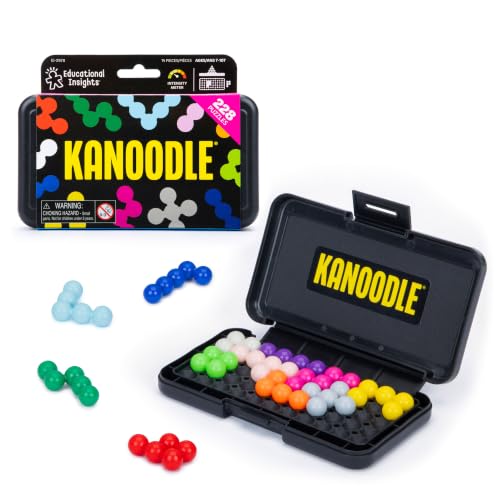
Kanoodle is the small purchase that solves dead time. Twelve connected-bead pieces and a puzzle book live inside a pocket-sized case, and each challenge asks the player to place some pieces as shown, then fit the rest into either a flat puzzle or a three-dimensional pyramid. With two hundred challenges, it suits car journeys, waiting rooms, and quiet mornings without any screen, charger, or table space. Adults regularly get stuck on the harder pyramids too, which makes it an unusually good gift across a wide age span within its stated range.
Specs
- Brand: Educational Insights
- Item model number: EI-2978
- Manufacturer recommended age: 7 to 11 years; title states ages 7 and up
- Includes: 12 puzzle pieces, 48-page illustrated puzzle book, and pocket-sized carrying case
- Play formats: 2D puzzles and 3D pyramids, 200 puzzle challenges
- Number of players: 1
- Product dimensions: 5.75 x 3.25 x 0.75 inches; item weight 3.2 ounces
Best for: Travel, quiet time, and a stocking-style gift that older kids and adults can share.
Watch out for: The pieces are small, so keep the case closed and stored away from children under the stated age range.
ASIN: B000FGECAI
Which One Fits Your Situation
A Birthday Gift When You Barely Know the Child
Reach for Kanoodle if the child is seven or older, or the PicassoTiles set for a younger or mixed-age household. Both explain themselves in minutes, need no other equipment, and do not depend on owning a particular device. Ask the parent one question first: the child’s age. That single answer decides between these two more reliably than any guess about interests, themes, or favourite colours ever will.
Homeschool Days That Need More Practical Work
Build the week around Snap Circuits Jr. and Osmo. The circuit kit supplies a sequence of projects an older child can work through in order, recording what each switch or circuit changed. Osmo covers maths and spelling practice on the days when building feels like too much setup. Together they give home learning a practical strand without turning the kitchen table into a permanent classroom display.
Cutting Screen Time Without Banning the Tablet Outright
Two routes work here. The stricter route is fully unplugged: Gravity Maze for an older child, Kanoodle for travel and short waits, and magnetic tiles when siblings play together. The compromise route is Osmo, which keeps the iPad but changes the child’s role from watching to moving, arranging, and drawing. Pick based on your household, then be consistent, because swapping rules midweek undermines either choice.
One Toy That Grandparents, Kids, and Guests All Use
Kanoodle earns this spot. It sits in a case on a coffee table, a visitor can start a flat puzzle within a minute, and the pyramid challenges give experienced players something harder. Gravity Maze works similarly for guests aged eight and up who like building. Either way, choose a game with visible levels, because watching someone else attempt the next challenge is what draws the next player in.
Common Mistakes
- Choosing by the word educational on the box instead of by the situation the toy needs to fit.
- Ignoring the manufacturer minimum age when buying for a mixed-age household with a toddler at home.
- Buying a tablet-based kit without checking whether the family’s exact device model is listed as compatible.
- Forgetting that circuit kits need batteries that are not included, which stalls the first project.
- Giving a single-player puzzle to siblings without a turn-taking plan, then blaming the toy for the argument.
Frequently Asked Questions
What makes a toy genuinely educational rather than just labelled that way?
Look for feedback built into the play itself. A marble that misses its target, a circuit that stays dark, or a puzzle piece that will not fit all tell the child something went wrong and invite another attempt. Toys that only play sounds or praise every tap give far less to reason about. Contents, levels, and a manual on the listing are good clues.
Which of these work best for homeschooling?
Snap Circuits Jr. and Osmo fit homeschool routines most naturally. The circuit kit follows a manual of projects arranged in order of complexity, which maps neatly onto weekly lessons for a child aged eight and up. Osmo adds structured maths, spelling, and drawing games for the primary years. The other picks support homeschool life as enrichment and quiet-time work rather than as a main teaching sequence.
How do I choose when siblings are several years apart?
Favour open-ended or leveled toys. Magnetic tiles let a younger child build freely beside an older sibling’s project, while Kanoodle and Gravity Maze let each player choose a challenge at their own level. Always anchor the choice to the youngest child’s safety, though: a product listed for eight and up should be stored out of a younger sibling’s reach between supervised sessions.
Are screen-free toys always the better option?
Not automatically. What a child does matters more than whether a screen is present. Osmo requires moving physical pieces, solving problems, and responding to feedback, which is active play despite the iPad. A screen-free toy that a child ignores teaches nothing. Match the format to the child in front of you, keep sessions purposeful, and rotate toys before interest fades completely.
Related guides
More from Amazon
Programs that pair well with the guide above. Offers and eligibility are set by Amazon and may change.
Free shipping on eligible items, Prime Video and more. Eligible new members can start with a free trial.
Start a Prime free trialAd-free music streaming. Eligible new subscribers can start with a free trial.
Try Music Unlimited freeA Prime membership for ages 18-24 with a trial period. Eligibility is set by Amazon.
See Prime for Young AdultsAudiobooks and podcasts to listen to on the go. Eligible new members can start with a free trial.
Try Audible freeAs an Amazon Associate we earn from qualifying purchases.






Write Your Review
No reviews yet. Be the first to share your experience!