
Key takeaways
- Start phonics, tracing and simple building at age four with five Amazon-listed toys matched to pre-reading skills, patience and turn-taking at home.
What's inside
As an Amazon Associate I earn from qualifying purchases. This post may contain affiliate links at no extra cost to you.
Choosing a learning toy for a four-year-old is really a decision about what comes next: recognising letter sounds, forming letters without frustration, or building something that stays up long enough to feel proud of. A toy that asks for reading too early will sit unused, while one pitched too young stops teaching within weeks.
This guide is for parents preparing a child for school, gift buyers who do not see the child every day, and carers building a small home learning shelf. Every pick below was chosen from its Amazon listing title and product details, with the manufacturer age, piece count and contents checked against that listing before inclusion. The five options deliberately cover different jobs, so one purchase can target the skill your child needs most right now.
Quick Picks
As an Amazon Associate we earn from qualifying purchases.
| Product | Best for | Key spec from title |
|---|---|---|
| LeapFrog Mr. Pencil’s Scribble, Write and Read, Green | Guided tracing with spoken prompts | Scribble, Write and Read |
| Melissa & Doug See & Spell Wooden Educational Toy | First three- and four-letter words | 8 Double-Sided Spelling Boards and 64 Letters |
| Melissa & Doug Self-Correcting Alphabet Wooden Puzzles | Matching upper- and lowercase letters alone | Wooden Puzzles with Storage Box (52 pcs) |
| MAGNA-TILES Classic 32-Piece Magnetic Construction Set | Simple STEM building without instructions | 32-Piece Magnetic Construction Set |
| ThinkFun Zingo Bingo | Learning to wait, watch and take turns | Bingo Award Winning Preschool Game for Pre-Readers |
How to Choose
Start from the sound, not the whole word
At four, phonics usually means hearing that a word begins with a particular sound and linking that sound to one letter shape. Toys that isolate that step, such as a board showing a picture beside a single missing letter, give a child a win they can repeat. Sets that jump straight to full sentences tend to rely on memorised pictures instead. Check the listing for whether the activity works at letter level first, and whether an adult can cover part of a word to make the task smaller on a tired day.
Tracing should show stroke order
Copying a letter shape and forming it correctly are different skills. A four-year-old who starts a letter in the wrong place often has to unlearn that habit later, so look for tracing tools that show a starting point and a direction, ideally step by step. Reusable surfaces matter too, because repetition is where the learning happens and paper workbooks run out quickly. Note whether a device needs batteries, since a flat battery at the wrong moment can end a short practice session entirely.
Building toys need success in the first five minutes
Simple construction teaches early STEM thinking when a child can predict what happens next: this triangle roofs that square, that wall needs a wider base. Magnetic tiles suit this age because pieces connect in many orientations, so early attempts rarely collapse for no clear reason. Look at the mix of shapes in the listing rather than the headline piece count. A set with only squares limits what can be built, while one mixing squares with three triangle shapes supports houses, towers and simple patterns.
Rules should be short enough to hold in memory
Patience with rules grows when the rule set is tiny and visible. A first group game for this age should need no reading, use a picture the child can check themselves, and finish before attention fades. Two to six players is a practical range for family play, and double-sided cards that add a harder level help a game last beyond a few months. Avoid games where one player waits through long turns with nothing to watch, because spectating is the part four-year-olds find hardest.
The 5 Best Options
LeapFrog Mr. Pencil’s Scribble, Write and Read, Green

This is the pick for a child who wants to write letters but still reverses shapes or starts them in odd places. The device guides tracing in proper order and also covers sounding out words, so letter formation and early phonics sit in one short activity rather than two separate ones. Because the child can personalise practice with their own name, sessions often start willingly, which matters more at this age than any single feature. It suits short, regular practice at a table.
Specs
- Brand: LeapFrog
- Manufacturer recommended age: 36 months to 5 years
- Item model number: 80-617000
- Product dimensions: 2.05 x 7.72 x 8.62 inches
- Item weight: 15.2 ounces
- Batteries: 3 AA batteries required, included for demo purposes only according to the listing
Best for: Children who need guided letter and number tracing before school.
Watch out for: The listing says new batteries are recommended for regular use, so plan for replacements; also supervise younger siblings around batteries.
ASIN: B0BRXPG99Q
Melissa & Doug See & Spell Wooden Educational Toy
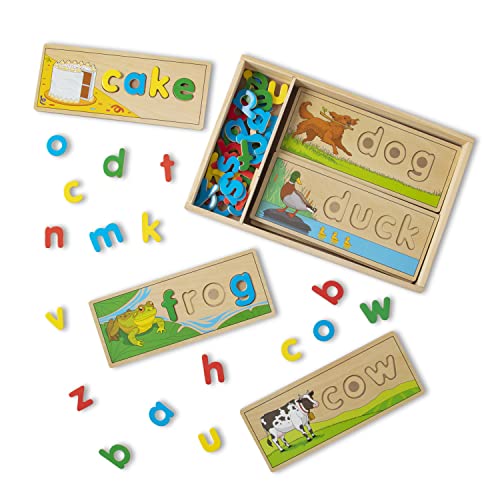
Choose this wooden set when a child knows many letter names and is ready to assemble short words. Eight double-sided boards present three- and four-letter words beside pictures, and the child places matching wooden letters into the cut-out spaces. That physical placement slows the task down in a useful way: each sound gets handled one at a time. It also works as a stencilling and letter-sorting activity once the boards feel easy, which stretches its useful life well past the first spelling attempts.
Specs
- Brand: Melissa & Doug
- Manufacturer minimum age: 48 months
- Manufacturer maximum age: 72 months
- Included components: 64 wooden letters, 8 puzzle boards
- Item model number: 000772029407
- Manufacturer part number: 2940
- Item weight: 2.6 pounds
Best for: A first spelling activity using three- and four-letter words.
Watch out for: The listing describes lowercase wooden letters, so a child still confusing letter cases may need an adult nearby; small letters should be kept away from much younger children.
ASIN: B0007Y4DLG
Melissa & Doug Self-Correcting Alphabet Wooden Puzzles

Where See & Spell builds words, this puzzle set works one letter pair at a time, which is the better starting point for a child still mixing up upper- and lowercase forms. Each two-piece puzzle joins a letter with a labelled illustration, and pieces only fit their correct match, so a child can discover an error without being told. That self-checking quality makes it genuinely usable alone for a few minutes. The wooden storage box also gives tidying up a clear, finishable endpoint.
Specs
- Brand: Melissa & Doug
- Manufacturer minimum age: 48 months
- Manufacturer maximum age: 72 months
- Number of pieces: 52
- Included components: 26 two-piece letter puzzles
- Age range description on listing: 4+ years
- Manufacturer part number: 2541
Best for: Independent practice matching uppercase and lowercase letters.
Watch out for: With 52 pieces, a few can wander; count pieces back into the box with your child, and check the listing age of four and up before giving it to a younger toddler.
ASIN: B004PBNGEM
MAGNA-TILES Classic 32-Piece Magnetic Construction Set
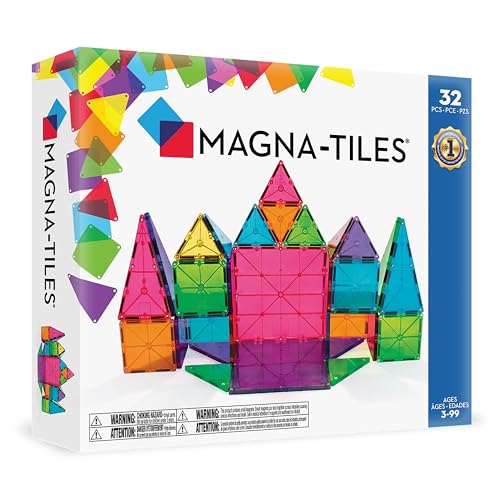
For a child who learns by making things, this 32-piece set is the building option that asks for no instructions and no reading. Squares and three kinds of triangle connect along their edges, so a flat pattern can fold up into a box or tower and the cause of a collapse is usually visible. The translucent colours in six shades also invite sorting and pattern work on a light surface. It is a starter quantity, best for solo building and simple structures rather than large shared creations.
Specs
- Brand: MAGNA-TILES
- Manufacturer recommended age: 3 years and up
- Number of pieces: 32
- Included: 2 large squares, 14 small squares, 8 equilateral triangles, 4 right triangles, 4 isosceles triangles
- Colours: 6 different colours, translucent shapes
- Item dimensions: 16 x 1.5 x 12 inches
- Item weight: 2.7 pounds
Best for: First magnetic building, patterns and simple towers.
Watch out for: The listing age starts at three years, and the product contains magnets, so follow the listing warnings, keep damaged tiles out of use, and keep the set away from children under three.
ASIN: B000CBSNKQ
ThinkFun Zingo Bingo

Zingo turns rule-following into a fast picture-matching race that a pre-reader can genuinely join. A tile dispenser reveals pictures, players check their own cards, and the first to fill a card wins, so waiting time stays short and everyone watches every reveal. The two levels on the double-sided cards let an adult slow the game down for a new player or add competition later. With two to six players listed, it covers a sibling pair as easily as a small group of friends.
Specs
- Brand: ThinkFun
- Manufacturer recommended age: 4 to 10 years
- Manufacturer minimum age: 48 months
- Number of players: 2-6
- Included components: 6 double-sided Zingo cards with 2 levels of play, 72 double-sided tiles, parent’s guide, Zingo Zinger
- Item model number: 97700
- Material on listing: Plastic
Best for: A first group game that practises waiting and turn-taking.
Watch out for: Tiles are small game parts, so store them in the box after play and keep them from younger children who still mouth objects.
ASIN: B01DY818JG
Which One Fits Your Situation
Your child recognises letters but cannot form them
Start with the LeapFrog Mr. Pencil device, because its guided tracing addresses formation directly rather than hoping copying will fix it. Keep sessions brief and frequent, and let name writing be the reward activity at the end. Add the self-correcting alphabet puzzles later, once letter shapes feel familiar in both cases.
Word building is emerging, one sound at a time
Pick See & Spell if your child can already name most letters and enjoys finishing a visible task. The boards limit each attempt to one short word, which keeps help manageable. Choose the alphabet puzzles instead if matching cases is still shaky, since that skill sits underneath spelling and should come first in practice.
You need something siblings can share without arguing
Zingo is the shared option here, since every player watches the same tile reveal and checks a personal card. Its listed range of two to six players fits most family combinations. For parallel play rather than a shared game, the MAGNA-TILES set lets two children build side by side, although 32 pieces will be divided quickly.
Screen-free quiet time after lunch
The two Melissa & Doug wooden sets suit a calm table activity because neither needs batteries, setup or sound. The alphabet puzzles offer the clearest solo task, as the self-correcting fit tells the child whether an answer works. Rotate a few puzzles out at a time so the activity stays short and finishable.
Common Mistakes
- Buying for the age on a birthday card rather than the manufacturer age and skill step on the listing.
- Choosing a spelling toy before a child can match upper- and lowercase letters reliably.
- Treating a large piece count as better, when a smaller set with the right shape mix gets used more.
- Letting tracing practice run long; short daily attempts build formation habits better than one long session.
- Leaving small letters, tiles or magnetic pieces within reach of children under three.
Frequently Asked Questions
How much practice time is enough at age four?
Short and regular beats long and rare. Ten focused minutes on tracing or one spelling board, repeated across the week, gives a four-year-old repetition without the frustration that ends learning. Stop while the activity still feels successful, and return tomorrow. Consistency matters because letter formation is a motor habit, and habits form through frequent small attempts rather than occasional effort.
Should my four-year-old learn upper- or lowercase first?
Both appear in early reading, but lowercase letters dominate the words in picture books. A sensible order is to recognise the child’s own name first, then match upper- and lowercase pairs using a self-checking puzzle. The Melissa & Doug alphabet puzzles do exactly that pairing. Avoid drilling one case in isolation for months, because switching between cases is itself part of the skill school expects.
Are magnetic tiles safe for a four-year-old?
The MAGNA-TILES listing gives a manufacturer age of three years and up, and the tiles are made for that age group. Safety still depends on condition and supervision: check tiles regularly, remove any damaged piece from play, and keep magnetic toys away from children under three. Never let a child chew or pry at a tile, and store the set where a toddler sibling cannot reach it.
What if my child refuses anything that looks like schoolwork?
Choose the toy that hides the skill inside a different goal. Zingo feels like a race, yet it practises picture and word matching plus waiting for a turn. Magnetic tiles feel like building, yet they teach shape, symmetry and planning. Start there, let confidence grow, and introduce the more obviously educational spelling boards once your child already believes they are good at learning games.
Related guides
More from Amazon
Programs that pair well with the guide above. Offers and eligibility are set by Amazon and may change.
Free shipping on eligible items, Prime Video and more. Eligible new members can start with a free trial.
Start a Prime free trialAd-free music streaming. Eligible new subscribers can start with a free trial.
Try Music Unlimited freeA Prime membership for ages 18-24 with a trial period. Eligibility is set by Amazon.
See Prime for Young AdultsAudiobooks and podcasts to listen to on the go. Eligible new members can start with a free trial.
Try Audible freeAs an Amazon Associate we earn from qualifying purchases.




Write Your Review
No reviews yet. Be the first to share your experience!