
Key takeaways
- Compare the best educational toys for 1 year old babies, from stacking rings to shape sorters, with age, size and safety details from Amazon listings.
What's inside
As an Amazon Associate I earn from qualifying purchases. This post may contain affiliate links at no extra cost to you.
Choosing a toy for a first birthday is really a decision about fit, not novelty. At twelve months most babies grab with a whole fist, mouth almost everything, and repeat one simple action dozens of times, so a toy that is too small, too fiddly, or meant for an older child gets ignored or becomes unsafe. The useful question is whether the pieces suit small hands and whether the action, stacking, posting, or pounding, rewards a child who is only just learning cause and effect.
This guide is for parents, grandparents, and gift buyers shopping for a child around one year old, including babies who are sitting confidently and those taking early steps. Every pick was chosen from its Amazon product title and listing details, including the manufacturer age, piece count, dimensions, and materials stated there, so you can check the same facts before you buy.
Quick Picks
As an Amazon Associate we earn from qualifying purchases.
| Product | Best for | Key spec from title |
|---|---|---|
| Fisher-Price Rock-a-Stack | First stacking and shaking play | 5 colorful rings for ages 6+ months |
| Fisher-Price Baby’s First Blocks | Fill, dump, and early shape posting | Set of 10 shapes for ages 6+ months |
| Melissa & Doug K’s Kids Take-Along Shape Sorter | Soft sorting away from home | 9 textured blocks for babies 9 months and up |
| MEGA BLOKS First Builders Big Building Bag | First building with very large blocks | 80 pieces with storage for ages 1+ years |
| Hape Pound & Tap Bench with Slide Out Xylophone | Pounding that turns into sound | Slide out xylophone for toddlers |
How to Choose
Start With the Manufacturer Age on the Listing
Age grading is the first filter, because it reflects the size of the pieces and the skill the maker expects. For a one-year-old, look for listings that state six months and up, nine months and up, or one year and up, and read the exact manufacturer minimum age in the product details rather than relying on a gift guide headline. A sorter graded from two years may have smaller shapes or a trickier lid. Never give a toy below the age the manufacturer states, even if a child seems advanced, because that grading also covers mouthing and choking risk.
Pick Pieces Built for a Whole-Hand Grasp
Around the first birthday, children are moving from raking objects toward a neater pinch, but they still need chunky shapes they can palm and release on purpose. Rings that fit over a post, blocks that fill a bucket, and extra-large building blocks all let a baby succeed without precise finger control. Check the listing dimensions before you order. A ring stacker that stands under eight inches tall, for example, sits at a manageable scale for floor play, while tiny pieces that disappear into a fist are a warning sign for this age group.
Match the Action to Simple Cause and Effect
Learning at this stage looks repetitive because repetition is the lesson. A baby drops a block, hears it land, tips the bucket, and starts again, gradually linking an action to its result. Toys with one clear payoff work best: balls that tinkle across xylophone keys when pounded, a smallest ring that rattles when shaken, or a lid that only accepts the matching shape. Sound should come from the child’s own movement rather than from constant electronic noise, so the connection between hand and outcome stays obvious and the play stays calm.
Check Mouthing Safety and Cleaning in the Details
Everything will be mouthed, so the listing details matter more than marketing claims. Look for the materials the seller actually names, such as plastic, wood, or water-based paint, and note any age warning printed on that page. Large, single-piece shapes are easier to supervise than sets with detachable small parts, and smooth surfaces wipe clean after teething. If a listing does not state a material or an age, treat that as a reason to choose a different product rather than guessing, and always supervise play with balls and loose blocks.
The 5 Best Options
Fisher-Price Rock-a-Stack
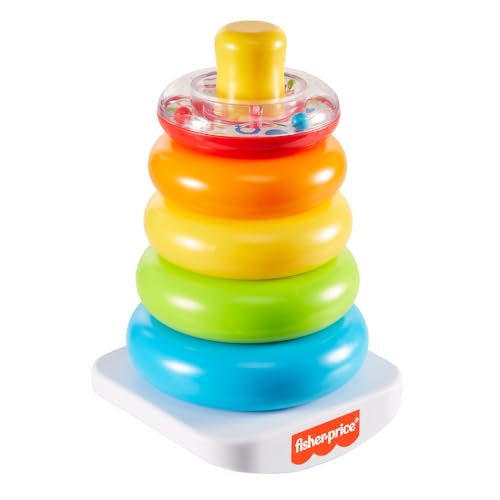
Few toys suit a one-year-old as directly as a ring stacker, because pulling rings off is achievable long before putting them back in size order. This Fisher-Price version adds a roly-poly base that rocks when batted, plus a smallest ring with swirling beads inside that rattles when shaken, giving a seated baby two distinct payoffs. It suits families who want a compact, battery-free first toy for grasping, shaking, and early sequencing on the floor.
Specs
- Manufacturer minimum age: 6 months, from the listing
- Included components: 1 stacking post and 5 rings
- Dimensions: 5.12 x 4.72 x 7.76 inches
- Material: Plastic and rubber, as listed
- Batteries: No batteries required
Best for: Babies who are sitting and grasping and need a first stacking toy with a shaking, rattling reward.
Watch out for: The listing gives a maximum age figure that is clearly a data error, so rely on the stated minimum of 6 months and supervise the loose rings during play.
ASIN: B07M9233QG
Fisher-Price Baby’s First Blocks

This bucket set understands that, at one, filling and dumping usually come before true shape matching. Ten chunky blocks can be dropped through the shape-sorting lid, carried by the handle, or simply tipped out and collected again, which is exactly the grasp-and-release practice this age needs. It is a sensible choice for parents who want one open-ended sorter that stores its own pieces and grows from random posting toward naming colors and matching shapes over the coming months.
Specs
- Manufacturer recommended age: 6 months to 5 years
- Contents: Bucket with handle, shape-sorting lid, and 10 shape blocks
- Dimensions: 5.12 x 4.92 x 8.27 inches
- Item model number: FFC84
- Manufacturer: Fisher-Price
Best for: One-year-olds who love putting objects in and out and are just beginning to attempt a sorting lid.
Watch out for: True shape matching will take time, so expect dumping play first, and keep the ten loose blocks together so none are left where a mouthing baby plays unsupervised.
ASIN: B01NCUSC7V
Melissa & Doug K’s Kids Take-Along Shape Sorter

Where the Fisher-Price bucket is hard plastic, this Melissa & Doug sorter is a soft, two-sided activity bag, which changes where and how it gets used. Nine textured blocks post through the padded panel, and the whole toy travels more comfortably in a car or stroller basket. It fits caregivers who want a quieter, softer sorter for a baby from nine months, especially for visits or travel days when hard, clattering pieces are less welcome and a carry-along format matters.
Specs
- Manufacturer recommended age: 9 months to 3 years
- Contents: 9 textured shape blocks and soft activity bag
- Item model number: MND9185
- Age range in listing title: Babies 9 months and up
- Manufacturer: Melissa & Doug
Best for: Families who want a soft, portable shape sorter for a baby aged nine months and older.
Watch out for: The listing describes a soft bag rather than a rigid box, so check the current page photos for the panel layout, and supervise posting play as with any loose-block toy.
ASIN: B00EYTM9IY
MEGA BLOKS First Builders Big Building Bag

Big blocks solve a specific one-year-old problem: ordinary construction pieces are far too small for safe mouthing and clumsy stacking. This First Builders bag holds eighty oversized blocks sized for little hands, in the blue colorway, with a reusable storage bag for cleanup. Two blocks clicking together, then a short tower that topples, is achievable building at this age. Choose it if you want a first construction set that siblings can also use and that will still be relevant well past the second birthday.
Specs
- Manufacturer age in title: Ages 1+ years
- Number of pieces: 80
- Contents: Building blocks with storage bag
- Model name: MEGA First Builders Big Building Bag
- Brand: MEGA BLOKS
Best for: Toddlers aged one and up who are ready to press together very large blocks and knock down simple towers.
Watch out for: Eighty pieces spread quickly across a floor, so use the storage bag from day one, and confirm you have selected the blue or pink listing variant you intended before ordering.
ASIN: B007GE75HY
Hape Pound & Tap Bench with Slide Out Xylophone

Pounding is honest work for a one-year-old, and this wooden bench turns that impulse into music without needing batteries. Tapping the three balls sends them rolling over the xylophone keys underneath, or an adult can slide the xylophone out so the child taps the keys directly with the mallet. The listing states twelve months and up, which matches the first-birthday brief exactly. It suits a child who bangs everything in reach and a household that prefers wood and water-based paint finishes.
Specs
- Manufacturer minimum age: 12 months; maximum age 36 months
- Dimensions: 9.45 x 5.91 x 5.31 inches
- Material: Wood, water-based paint, PA, and metal, as listed
- Model number: E0305
- Batteries: No batteries required
Best for: One-year-olds who love banging and need a clear, musical result from each hit.
Watch out for: The set includes loose balls and a mallet, so supervise closely and store the balls between sessions; do not use it below the manufacturer’s stated 12 months.
ASIN: B00712O2D6
Which One Fits Your Situation
A First-Birthday Gift When You Do Not Know the Child Well
Pick the Fisher-Price Rock-a-Stack. Its listing starts at six months, it needs no batteries, and its five rings work for a baby who only grasps and shakes as well as one beginning to stack. That wide window makes it the safest gift choice here when you have not seen the child play and do not know which milestone comes next.
A Baby Who Only Wants to Fill, Tip, and Empty
Choose Fisher-Price Baby’s First Blocks. The bucket rewards dumping as much as sorting, the handle invites carrying, and all ten blocks store inside. A one-year-old who ignores puzzles but happily posts objects into containers will get more daily use from this set than from a toy that demands correct answers from the start.
Regular Car Journeys and Visits to Relatives
The Melissa & Doug Take-Along Shape Sorter fits this routine best. Its soft bag format and nine textured blocks are designed for babies nine months and up, and the padded construction travels without the hard edges of a plastic bucket. It gives a baby a familiar posting activity in an unfamiliar room, which often settles play on the move.
A Home That Prefers Wood and No Batteries
Go with the Hape Pound & Tap Bench, and add the MEGA BLOKS bag later if building takes off. The Hape listing names wood and water-based paint, states twelve months and up, and makes its sound mechanically. That combination suits families deliberately avoiding electronic toys at this age while still wanting a strong cause-and-effect payoff.
Common Mistakes
- Buying a sorter or puzzle graded from age two or three because it looks more educational, even though its pieces and difficulty miss a one-year-old.
- Choosing sets with small detachable parts for a baby who mouths everything, instead of checking the manufacturer minimum age on the listing.
- Assuming more pieces means more learning; eighty big blocks work because of their size, not their count, and ten well-sized shapes beat a large set of tiny ones.
- Picking a loud electronic toy when a simple mechanical action, a rattle, a rolling ball, or a posting lid, teaches cause and effect more clearly.
- Leaving loose balls, rings, and blocks scattered between sessions instead of storing each set in its bucket or bag and supervising play.
Frequently Asked Questions
What makes a toy educational at one year old?
At this age, education means grasping, releasing, stacking, posting, and noticing that an action produces a result. A ring that rattles, a block that drops through a matching hole, or a ball that makes a note when pounded all teach more than printed letters on a toy a baby cannot yet use or understand.
How many toys does a one-year-old actually need?
A small rotation is enough. One stacker, one posting or sorting toy, and one set of large blocks cover the main hand skills of this stage, with room to add a pounding or push toy later. Too many similar sorters at once usually means none of them gets the repetition that builds the skill.
Are wooden toys safer than plastic toys for mouthing?
Material alone does not settle safety. What matters is the manufacturer age on the listing, the size of each piece, and the finish the seller names, such as water-based paint on the Hape bench. Check those details on the product page, wipe any new toy clean, and supervise mouthing whatever the material.
When will a baby actually solve a shape sorter?
Most one-year-olds begin by posting shapes randomly, mouthing them, or dumping the container, and only gradually match a shape to its hole. That early stage is still valuable practice. If matching is the goal, start with a set with fewer, chunkier shapes, and expect real sorting to emerge over the following months rather than at the first birthday.
Related guides
More from Amazon
Programs that pair well with the guide above. Offers and eligibility are set by Amazon and may change.
Free shipping on eligible items, Prime Video and more. Eligible new members can start with a free trial.
Start a Prime free trialAd-free music streaming. Eligible new subscribers can start with a free trial.
Try Music Unlimited freeA Prime membership for ages 18-24 with a trial period. Eligibility is set by Amazon.
See Prime for Young AdultsAudiobooks and podcasts to listen to on the go. Eligible new members can start with a free trial.
Try Audible freeAs an Amazon Associate we earn from qualifying purchases.




Write Your Review
No reviews yet. Be the first to share your experience!