
Key takeaways
- Compare large building bricks, a chunky shape puzzle, a talking word book and fine-motor play matched to how two-year-olds actually learn and move.
What's inside
As an Amazon Associate I earn from qualifying purchases. This post may contain affiliate links at no extra cost to you.
Choosing a toy for a two-year-old is really a decision about fit: can small hands grip it, push it together, pull it apart, and carry it across the room without help? At this age children learn by doing things over and over — stacking until a tower falls, naming an animal for the tenth time, copying you sweeping the floor. A toy that is too fiddly gets abandoned, however clever its packaging sounds.
This guide is for parents buying a first building set, grandparents who want one gift that will actually get used, and caregivers setting up a small play corner. Every pick below was chosen from its Amazon listing — its title, manufacturer age range, piece count, and stated contents — and matched to four things two-year-olds do daily: simple pretend play, building with large pieces, a fast-growing vocabulary, and big, whole-body movement.
Quick Picks
As an Amazon Associate we earn from qualifying purchases.
| Product | Best for | Key spec from title |
|---|---|---|
| LEGO DUPLO Classic Brick Box 10913 | A first building set with figures for pretend play | 65 pieces, ages 1.5 years and up |
| MEGA BLOKS First Builders Big Building Bag, Blue | The biggest, easiest bricks for small hands | 80 pieces, ages 1 year and up |
| Melissa & Doug Shapes Wooden Chunky Puzzle | A first puzzle with pieces that stand up for play | 8 pieces, ages 2 years and up |
| LeapFrog Learning Friends 100 Words Book | Naming words during the vocabulary burst | More than 100 words, ages 18 months and up |
| Learning Resources Spike the Fine Motor Hedgehog, Pink | Push-in, pull-out play that strengthens little hands | 12 quills, ages 18 months and up |
How to Choose
Start With the Manufacturer Age on the Listing
Ignore the age printed in a gift guide and read the age the manufacturer gives on the Amazon listing itself. That range reflects piece size and how the toy is meant to be handled. A set listed from 18 months, like the DUPLO brick box and the Spike hedgehog below, is built around chunky parts a two-year-old can grasp safely. A puzzle listed for ages 2 and up, like the chunky shapes puzzle, expects a child who can turn a piece and try a slot. Never buy down below the listed minimum to be ambitious: if a listing starts at age 3, wait, because the pieces and the task were not designed for a two-year-old mouth or grip.
Match the Toy to Simple, Copycat Pretend Play
Pretend play at two is mostly imitation. A child feeds a figure, pushes a car, or copies a routine they watched that morning, and the story rarely lasts more than a few minutes. Toys that support this stage come with a recognisable character or object and very little plot to follow. The DUPLO box earns its place partly because its two figures and car let a tower become a house and a drive to the shops. When you compare listings, look for figures, vehicles, or familiar household objects in the contents list, and be wary of themed sets built around long stories a two-year-old cannot yet retell or follow.
Pick Building Pieces Sized for a Whole-Hand Grip
Two-year-olds grab with the whole hand, press with the palm, and pull pieces apart by force rather than finesse. Large bricks solve all three problems: they connect with a push, separate without a struggle, and are big enough to keep out of a mouth under supervision. Piece count matters less than piece size, but it does affect tidying up and how tall a first tower can go. The 80-piece MEGA BLOKS bag suits a child who wants quantity and very easy connections, while the 65-piece DUPLO box adds figures and numbered bricks. Either way, check the listing for a storage bag or box, because eighty loose bricks need a home.
Feed the Word Burst Without Turning Play Into Lessons
Between two and three, many children move from single words to short phrases, and they learn fastest by pointing, hearing a word, and saying it back during ordinary play. A toy helps when it names everyday things — animals, food, colours, actions — in short bursts a child can repeat. The LeapFrog book below organises more than 100 words into categories such as pets, mealtime, and colours, and adds a Spanish mode. What matters is not the headline word count but whether an adult can sit alongside, press a picture, and talk about it. If a listing promises early reading or writing for this age, treat that claim with suspicion and keep looking.
The 5 Best Options
LEGO DUPLO Classic Brick Box 10913
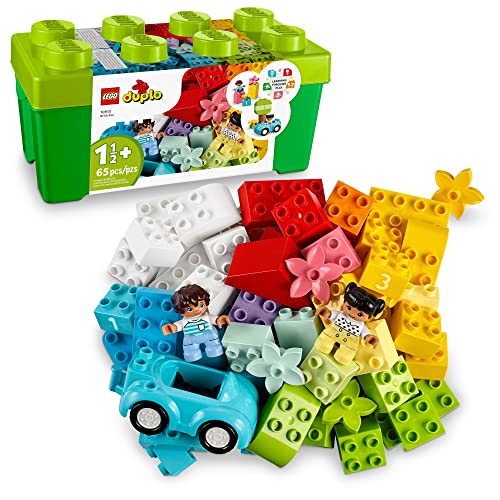
This is the set to choose when you want building and pretend play in one box rather than two separate toys. Alongside the bricks there is a car with moving wheels, a roof and window pieces, flowers, bread, and two figures, so a finished build immediately becomes somewhere people live. Numbered bricks marked 1, 2, and 3 slip early counting into ordinary stacking without turning it into a drill. The storage box matters at this age, too: clearing bricks back into one sturdy tub is a routine a two-year-old can genuinely help with at the end of the day.
Specs
- Brand: LEGO, DUPLO Classic, set 10913
- Pieces: 65 bricks and pieces, including 2 figures
- Manufacturer age: 18 months and up
- Contents from listing: car with moving wheels, roof, window, flowers, bread, and 1, 2, 3 numbered bricks
- Storage: sturdy storage brick box included
- Product dimensions from listing: 14.57 x 7.09 x 7.09 inches
Best for: A first and only building set for a child who already acts out little scenes with figures.
Watch out for: Confirm you are ordering set 10913, since several similar DUPLO brick boxes have different contents.
ASIN: B07WJJF8PB
MEGA BLOKS First Builders Big Building Bag, Blue

Where DUPLO adds characters, this bag keeps things deliberately plain: eighty large blocks and nothing else to learn first. That simplicity suits a younger two-year-old, or one who mainly wants to stack high, knock down, and start again. The blocks are the largest format in this guide, which makes the push-together connection the easiest here for a whole-hand grip. Because there are no figures or accessories, all eighty pieces go toward towers, walls, and long lines across the floor. The zip-up storage bag is part of the listing, so the whole set can be scooped away in one go after play.
Specs
- Brand: MEGA BLOKS, First Builders, model DCH63
- Pieces: 80 building blocks
- Manufacturer age: 1 year and up
- Colour version: Blue bag
- Storage: reusable storage bag included
Best for: A child who wants maximum bricks, the easiest connections, and tall towers to knock down.
Watch out for: There are no figures or vehicles in this set, so add pretend-play toys separately if your child wants characters.
ASIN: B007GE75HY
Melissa & Doug Shapes Wooden Chunky Puzzle

A first puzzle should forgive a clumsy attempt, and this one does. Each of the eight pieces is extra thick, so it sits proud of the board and can be lifted with a full fist instead of fingertips. Underneath every piece is a matching picture, which gives a child a second clue when the outline alone is not enough, and the shape name is printed on the board beside its slot. The eight shapes — circle, square, diamond, rectangle, triangle, heart, star, and oval — also stand up on their own, so finished pieces often end up in pretend play after the puzzle itself is done.
Specs
- Brand: Melissa & Doug, model 3730
- Pieces: 8 chunky wooden pieces
- Manufacturer age: 24 months to 4 years, per listing
- Material from listing: engineered wood
- Board: matching picture under each piece, shape name printed on the board
- Product dimensions from listing: 9 x 12 x 1 inches
Best for: A first puzzle for a child who likes sorting, naming shapes, and carrying pieces around.
Watch out for: With only eight pieces, a child who already completes larger puzzles will finish this quickly and need a harder next step.
ASIN: B000F676D8
LeapFrog Learning Friends 100 Words Book
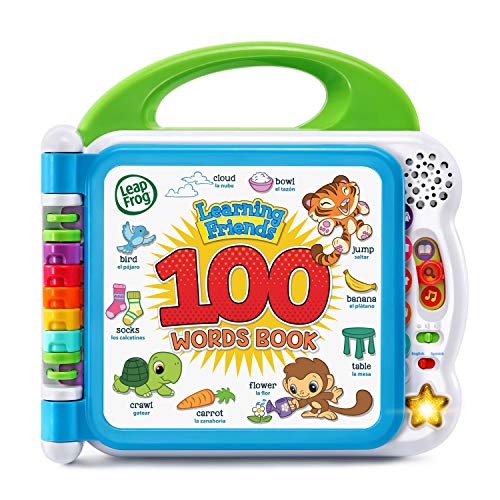
This interactive book fits the age because it asks for one simple action: touch a picture and listen. Three animal characters introduce more than 100 words across categories including pets, animals, food, mealtime, colours, activities, and opposites. Three play modes separate hearing the word, hearing its sound effect, and hearing a short fact, which keeps the same page useful as a child’s language grows. A language switch repeats words, songs, and instructions in Spanish as well as English. It is the only electronic pick in this guide, chosen because the interaction stays at pointing level rather than asking a two-year-old to follow on-screen instructions.
Specs
- Brand: LeapFrog, model 80-601540
- Content: more than 100 words in 12 learning categories, per listing
- Play modes: words, sound effects, and fun facts, plus a light-up star button for two theme songs
- Languages: English and Spanish
- Manufacturer age: 18 months to 4 years
- Power: 2 AA batteries required, included for demo purposes only per listing
- Product dimensions from listing: 9.17 x 9.37 x 1.89 inches
Best for: Lap time with an adult, naming games, and a child who repeats every new word they hear.
Watch out for: The included batteries are for demo purposes only according to the listing, so have fresh AA batteries ready, and keep volume and session length adult-led.
ASIN: B07B6ZN7P8
Learning Resources Spike the Fine Motor Hedgehog, Pink
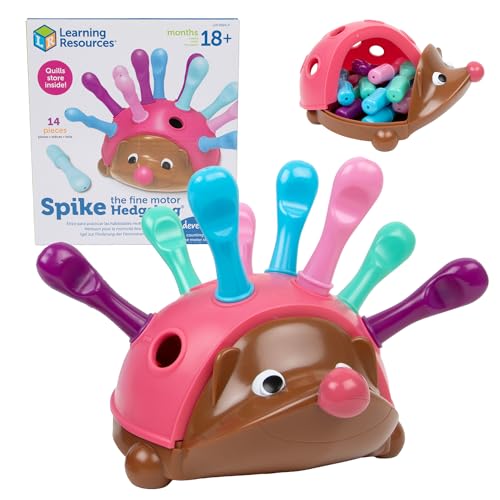
Spike turns a basic toddler urge — posting things into holes — into repeated hand exercise. The hedgehog has lost its quills, and a child pushes the twelve chunky, peg-shaped quills back into the holes along its back, then pulls them out and starts over. That push-and-pull builds grip and hand strength, while the coloured quills give adults an easy way to name colours and count to twelve during play. When the game ends, the quills store inside Spike’s body, which is a practical detail in a toy with twelve loose parts. This pink version carries the same format as the original Spike listing.
Specs
- Brand: Learning Resources, model LER8904-P
- Pieces: hedgehog body with 12 colourful peg-shaped quills
- Manufacturer age: 18 months to 4 years
- Storage: quills fit inside the hedgehog body, per listing
- Product dimensions from listing: 7.9 x 7.1 x 3.8 inches
Best for: Quiet, seated play that works on grip, posting, colour naming, and early counting.
Watch out for: The twelve quills are loose pieces, so play where an adult can see them and store them inside the body afterwards, as the listing describes.
ASIN: B08QM5NPR6
Which One Fits Your Situation
You Want One Gift That Covers Building and Pretend Play
Choose the LEGO DUPLO Classic Brick Box. It is the only pick here that combines a proper brick count with figures, a car, and house pieces, so it covers the two activities that fill most of a two-year-old’s day. The numbered bricks add gentle counting, and the storage box keeps a single-gift purchase tidy. If the child receiving it already owns plenty of plain bricks, this box still adds the figures and vehicle pieces those sets usually lack.
Your Two-Year-Old Is All Movement and Short Attention
Start with the MEGA BLOKS Big Building Bag. Eighty big blocks invite the gross-motor pattern this age loves: build something tall, push it over, laugh, and rebuild it somewhere else in the room. There are no small accessories to lose mid-game and no instructions to interrupt the flow. Pair it later with the Spike hedgehog for the opposite kind of play — sitting still and concentrating — once attention for seated activities starts to lengthen.
You Mostly Want Words, Naming, and Lap Time
Pick the LeapFrog Learning Friends 100 Words Book, and treat it as a shared activity rather than a solo entertainer. Its categories follow a toddler’s actual day — food, pets, colours, going outside — so the words it names are words your child can use at breakfast. The Spanish mode is a genuine bonus for bilingual households. Keep the chunky shapes puzzle nearby for a screen-free naming game once batteries and buttons lose their novelty.
Play Space Is Small and Everything Must Pack Away
Combine the two most self-contained picks: Spike, whose twelve quills store inside its own body, and the flat wooden shapes puzzle, which slides onto a shelf. Neither needs a play table, a charging cable, or a parts organiser. Between them they cover posting, gripping, shape naming, and colour naming in a footprint smaller than a single big building set, which suits a flat, a shared bedroom, or a grandparent’s house where toys cannot live out permanently.
Common Mistakes
- Buying a toy listed for ages 3 and up because a child seems advanced; the manufacturer’s minimum reflects piece size and safety, not intelligence, so respect it.
- Choosing tiny, detailed building sets meant for older children, whose small pieces frustrate a whole-hand grip and create a choking risk for under-threes.
- Counting features instead of actions: at two, one clear action repeated happily beats ten modes a child cannot trigger alone.
- Leaving loose-piece toys like peg quills out unsupervised, instead of storing pieces inside the toy or away between sessions.
- Expecting a talking toy to teach language by itself; children this age learn words fastest when an adult names, repeats, and responds alongside them.
Frequently Asked Questions
Are electronic toys a good idea at age two?
In small, shared doses, yes, provided the interaction is simple. The LeapFrog book in this guide only asks a child to touch a picture, then it names the word, which an adult can repeat and talk about. Problems start when a toy demands watching, waiting, or following multi-step prompts. Keep sessions short, sit together, and balance any electronic pick with bricks, puzzles, and outdoor movement every day.
How many pieces should a first building set have?
Enough to build something satisfying, few enough to tidy without tears. The sets here hold 65 and 80 pieces, and both include storage for that reason. Below roughly forty large pieces, towers stay frustratingly small; far above a hundred, clearing up becomes an adult-only job. Piece size matters more than the count anyway, so check that bricks are a large toddler format before comparing numbers between listings.
What should I check for safety before buying?
Read three things on the Amazon listing: the manufacturer minimum age, any small-parts or choking-hazard warning shown on that listing, and the piece count, so you know what must be stored. Do not use a toy below its listed age, supervise loose pieces, and inspect wooden and plastic parts for damage. If a listing’s age or warnings are unclear, choose a different product rather than guessing.
Should a two-year-old be learning letters and numbers yet?
Exposure is fine; drilling is not. Numbered bricks marked 1, 2, and 3, or counting twelve hedgehog quills aloud, plant familiarity while the real activity stays playful. Formal letter recognition and writing belong to later years, and no toy in this guide claims otherwise. If your child enjoys naming numbers, follow that interest. If they would rather build and demolish, that is what two-year-old learning is supposed to look like.
Related guides
More from Amazon
Programs that pair well with the guide above. Offers and eligibility are set by Amazon and may change.
Free shipping on eligible items, Prime Video and more. Eligible new members can start with a free trial.
Start a Prime free trialAd-free music streaming. Eligible new subscribers can start with a free trial.
Try Music Unlimited freeA Prime membership for ages 18-24 with a trial period. Eligibility is set by Amazon.
See Prime for Young AdultsAudiobooks and podcasts to listen to on the go. Eligible new members can start with a free trial.
Try Audible freeAs an Amazon Associate we earn from qualifying purchases.




Write Your Review
No reviews yet. Be the first to share your experience!