
Key takeaways
- Compare the best educational toys for 6 year olds, from screen-free coding and first science to logic games and interactive reading, with age checks.
What's inside
As an Amazon Associate I earn from qualifying purchases. This post may contain affiliate links at no extra cost to you.
Choosing for a six-year-old is really a decision about independence. Most children this age can follow a short sequence, read simple instructions with help, and stick with a challenge long enough to feel proud when it works, yet they still lose interest fast if setup falls entirely on an adult.
This guide is for parents buying a first coding or science set, relatives who want a birthday gift that is more than novelty, and families adding reading support alongside early chapter books. Every pick below was chosen from its Amazon listing, using the age range, contents, and requirements stated there. Nothing here needs skills far beyond first grade, and nothing is recommended below the age its maker states, so you can shop by interest first and then confirm the practical details.
Quick Picks
As an Amazon Associate we earn from qualifying purchases.
| Product | Best for | Key spec from title |
|---|---|---|
| Learning Resources Botley the Coding Robot 2.0 | First coding without a tablet | Screen-free coding for kids 5-7 |
| Thames & Kosmos Kids First Science Kit | A first real lab station | Intro to chemistry for ages 5+, 12 experiments |
| ThinkFun Rush Hour Jr. | Solo logic play in short sessions | Traffic Jam Logic Game, 40 challenges |
| LeapFrog LeapStart 3D Interactive Learning System, Green | Reading and school skills with audio support | Interactive Learning System, ages 2-7 |
| MAGNA-TILES Classic 32-Piece Magnetic Construction Set | Open-ended building every day | 32-Piece Magnetic Construction Set |
How to Choose
Start With What a Six-Year-Old Can Do Alone
Independence should drive the shortlist. A toy that needs an app paired, accounts created, or an adult reading every step will sit unused on ordinary weekdays, however impressive it looks on a birthday morning. Prefer sets a child can start after one demonstration: a remote programmer, a challenge card, or a stylus that reads the page. Botley 2.0 and Rush Hour Jr. both work that way. Save adult-led choices, such as a chemistry kit, for times when supervision is genuinely part of the fun rather than a hidden requirement.
Match the Skill, Not Just the Subject Label
STEM printed on a box tells you very little. Decide which thinking you actually want to practise. Sequencing and loops point toward a coding robot. Observing, pouring, and comparing results point toward a science kit. Planning several moves ahead points toward a sliding-block logic game. Early reading confidence points toward an interactive book system with leveled titles. Six-year-olds often read simple chapter books in short bursts, so a reading toy should support that pace with replayable pages rather than lock progress behind long lessons or a single story that ends quickly.
Check the Manufacturer Age Against Your Child
Age guidance is a safety and difficulty signal, not a marketing suggestion. Every product in this guide lists a minimum age of five or lower, which is why each one can suit a six-year-old without recommending play below the stated range. Still read the exact listing before buying. The science kit in this list warns that it is not suitable for children under three because small parts may be swallowed or inhaled, and its directions require an adult to accompany and supervise the child during experiments. Keep younger siblings away from small pieces.
Count the Ongoing Requirements Before You Buy
The first purchase is rarely the whole commitment. Botley 2.0 needs three AAA batteries for the robot and two AAA batteries for the remote programmer, and the listing says batteries are not included. LeapStart 3D needs three AA batteries and a computer with an internet connection to download books, while extra books in its library are sold separately. Science consumables also run out, even when the tools remain usable. None of this rules a toy out, but knowing it in advance prevents a disappointed first session.
The 5 Best Options
Learning Resources Botley the Coding Robot 2.0

Botley suits a six-year-old who is curious about robots but not ready for app-based programming. Children build a sequence with the remote programmer and coding cards, then watch the robot carry it out, spot where the plan went wrong, and fix the order. That try, observe, revise loop is the real lesson. Obstacle detection and black-line following add variety once basic sequences feel easy, and because no phone or tablet is required, play can start on the floor without setup or passwords.
Specs
- Brand: Learning Resources
- Model number: LER2941
- Manufacturer minimum age: 60 months; maximum age: 96 months
- Included components listed: cards, remote, robot
- Activity set described as 46 pieces, with 40 coding cards in the manufacturer section
- Power: AAA batteries; three for Botley and two for the remote programmer, not included
- Material: plastic; item dimensions 6 x 8 x 8 inches
Best for: A first coding toy for a child who learns by moving, testing, and trying again.
Watch out for: Budget for five AAA batteries before the first session, since none are included.
ASIN: B083T5G5ZK
Thames & Kosmos Kids First Science Kit

This kit fits the child who keeps asking why mixtures bubble, float, or change colour, and who is ready to follow a pictured sequence with an adult nearby. Its lab station gives pipettes, test tubes, and tools a fixed home, which makes experiments feel like real work rather than scattered craft supplies. Twelve activities introduce ideas such as surface tension, density, and buoyancy through making, pouring, and watching what happens. The full-colour manual explains each step, so a six-year-old can predict, test, and talk through the result.
Specs
- Brand: Thames & Kosmos
- Model number: 567022
- Manufacturer minimum age: 60 months; maximum age: 120 months
- Title states 12 experiments and 20+ durable tools
- Included components listed include 2 test tubes with lids, 2 pipettes, 4 packets of blue alginate powder, dye tablets, plastic lab station parts, spatula, tweezers, and stickers
- Manual: 28-page, full-colour
- Material: plastic; assembly required
Best for: Weekend science with a parent who wants guided, practical experiments rather than a pretend set.
Watch out for: The listing warns it is not suitable for children under 3 years, with a choking hazard from small parts, and says to always accompany and supervise your child during experiments.
ASIN: B0DSCJFN67
ThinkFun Rush Hour Jr.

Rush Hour Jr. works well for a child who enjoys puzzles but tires of worksheets. Each card sets up a traffic jam, and the player slides blocking vehicles to free the ice cream truck. Early challenges teach the movement rules gently, then later cards demand genuine planning, because moving one vehicle without thinking can block the exit two moves later. It is a single-player game with no batteries and no setup beyond placing vehicles from a card, so it fills ten quiet minutes productively and packs into its travel bag afterwards.
Specs
- Brand: ThinkFun
- Model number: 44005041
- Manufacturer minimum age: 60 months
- Included components: 40 challenge cards and solutions across 4 levels of play, 1 ice cream truck, 15 blocking vehicles, 1 game grid, 1 travel bag
- Number of players: 1
- Material: plastic
- Item dimensions: 8.88 x 2.5 x 8 inches
Best for: Short, screen-free logic practice that a six-year-old can start and reset alone.
Watch out for: The fifteen blocking vehicles are loose pieces, so use the travel bag and keep them away from younger siblings.
ASIN: B00GRV5JNY
LeapFrog LeapStart 3D Interactive Learning System, Green

LeapStart 3D is the reading-centred pick for a child moving from picture books toward short chapter books who still benefits from hearing words aloud. The stylus reads invisible dots on each page and triggers questions, songs, and challenges, while the 3D system adds animations for compatible books. Activities replay at two levels, so a child can revisit a book after a few weeks and meet harder questions. It supports phonics, reading, maths, and problem solving in one handled unit that travels easily between home, car, and grandparents.
Specs
- Brand: LeapFrog; manufacturer listed as VTech
- Model number: 80-603900
- Age range listed: 2 to 7 years
- Included components: LeapStart 3D system, stylus, sample book, USB cord, parent guide, readiness guide, quick start guide
- Library described as 25+ books, each sold separately, with 30+ activities per book
- Batteries: 3 AA batteries required
- Item weight: 2.39 pounds; dimensions 1.89 x 9.65 x 11.3 inches
Best for: Building reading confidence alongside school work and early chapter books.
Watch out for: Only a sample book is included, extra library books are sold separately, and a computer with an internet connection is required to download books onto the system.
ASIN: B07B72FXLQ
MAGNA-TILES Classic 32-Piece Magnetic Construction Set
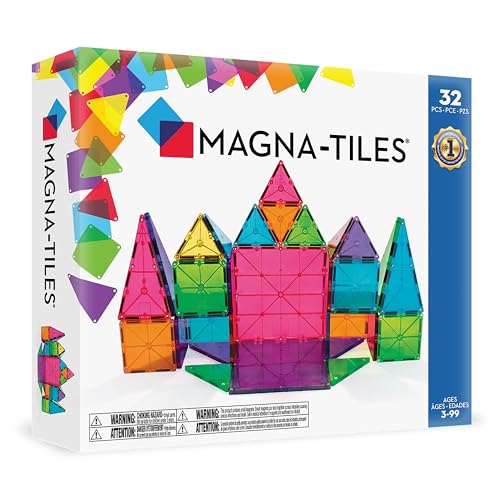
Magnetic tiles earn their place here because six-year-olds build differently from preschoolers. They plan houses with rooms, garages with ramps, and towers they intend to keep standing, and translucent pieces let them test symmetry and balance visually as they go. This original 32-piece set mixes squares and triangles in six colours, which is enough for solo builds and small shared projects without overwhelming tidy-up time. There are no instructions to outgrow and no levels to finish, so the same set supports geometry talk one day and imaginative play the next.
Specs
- Brand: MAGNA-TILES
- Item model number: 2132
- Contents listed: 32 translucent geometric shapes in 6 colours, including 2 large squares, 14 small squares, 8 equilateral triangles, 4 right triangles, and 4 isosceles triangles
- Product dimensions: 11.73 x 2.13 x 10.04 inches
- Item weight: 2.67 pounds
- Educational objectives listed include fine motor and spatial skills, shape recognition, and teamwork
Best for: Daily open-ended building that quietly practises shapes, symmetry, and spatial planning.
Watch out for: Thirty-two pieces suit one child or a small shared build; larger group constructions will need an additional set, sold separately.
ASIN: B000CBSNKQ
Which One Fits Your Situation
Your Child Asks How Robots Follow Instructions
Choose Botley 2.0. A six-year-old can lay out a sequence, run it, and immediately see whether the robot turned, stopped, or followed a line as intended. Because the programmer is a physical remote rather than an app, the conversation stays on the plan itself. Start with short routes around furniture, then let your child design an obstacle course and debug it when Botley takes an unexpected turn.
You Want Science That Feels Like Real Experimenting
Pick the Thames & Kosmos kit when an adult can join in. The station, test tubes, and pipettes turn abstract words like density into things a child can pour and compare. Work through one experiment at a time, ask for a prediction first, and keep the manual nearby for reference. Supervision is required by the listing, so treat this as shared weekend time rather than independent play.
Quiet Time Needs to Stay Challenging
Rush Hour Jr. fills this gap best. One player, one card, and a grid that resets in seconds make it easy to pause for dinner and return later. A six-year-old who finishes the easy cards quickly still has three harder levels waiting. Keep the set where homework and reading happen, and it becomes a natural break that still asks for planning, patience, and checking before moving.
Reading Practice Needs a Boost Outside School Books
LeapStart 3D is the practical choice when a child enjoys being read to but hesitates to read alone. The stylus gives instant audio support without an adult hovering over every word, and two activity levels let the same book stretch further. Pair it with one library book matched to your child’s current level rather than several at once, and add new titles as confidence grows.
Common Mistakes
- Buying an 8+ logic or electronics set for a six-year-old and expecting independent play, instead of checking the manufacturer minimum age on the listing.
- Forgetting batteries, so a coding robot or interactive book system cannot be used on the day it is opened.
- Treating a chemistry kit as unsupervised play, when its listing requires an adult to accompany and supervise the child.
- Adding several expansion books or extra tile sets at once, before you know which activity your child returns to.
- Leaving small vehicles, test tube parts, or other small pieces within reach of children under three.
Frequently Asked Questions
Does a six-year-old need a tablet for coding toys?
No. Botley 2.0 in this guide codes entirely without a phone or tablet, using a remote programmer and coding cards. That matters at six because setup friction often decides whether a toy gets used. A child can start a sequence on the floor, watch the result, and change the order, all without passwords, pairing, or an adult handing over a device.
How much adult help do these toys need?
It varies by type. Rush Hour Jr. and the magnetic tiles can be used independently once the basic idea is shown. LeapStart 3D needs an adult for initial downloads and new books. The science kit needs the most involvement because its listing instructs adults to read the manual with the child, follow it, and supervise every experiment session.
Can these toys support a child starting chapter books?
Yes, indirectly and directly. LeapStart 3D works on phonics, vocabulary, and reading through interactive books with two activity levels, which builds confidence between school reading sessions. Logic games help too, because following a challenge card, holding a plan in mind, and checking a result are the same habits a new reader uses to follow a short chapter from start to finish.
What should I check before giving one as a gift?
Confirm three things on the listing: the manufacturer age range covers six, the batteries or device the toy needs, and whether extra books or pieces are sold separately. Also ask whether younger siblings live in the home, because several picks here contain small parts. A quick message to the parent about those points prevents most gift mismatches.
Related guides
More from Amazon
Programs that pair well with the guide above. Offers and eligibility are set by Amazon and may change.
Free shipping on eligible items, Prime Video and more. Eligible new members can start with a free trial.
Start a Prime free trialAd-free music streaming. Eligible new subscribers can start with a free trial.
Try Music Unlimited freeA Prime membership for ages 18-24 with a trial period. Eligibility is set by Amazon.
See Prime for Young AdultsAudiobooks and podcasts to listen to on the go. Eligible new members can start with a free trial.
Try Audible freeAs an Amazon Associate we earn from qualifying purchases.






Write Your Review
No reviews yet. Be the first to share your experience!