
Key takeaways
- Prepare a five-year-old for first grade with early reading, adding and subtracting, turn-taking games and simple experiments from five listed toys.
What's inside
As an Amazon Associate I earn from qualifying purchases. This post may contain affiliate links at no extra cost to you.
For a five-year-old, the real question is not whether a toy is educational in general, but whether it rehearses what the first year of school will actually ask: reading a short book alone, showing how a number splits into two parts, waiting through somebody else’s turn, and following steps in order until something happens.
The families this shortlist serves include parents bridging the gap between kindergarten and first grade, home educators who need manipulatives rather than worksheets, and gift buyers wanting a present that still teaches in six months. Each entry was selected from its Amazon listing, and the ages, contents and piece counts quoted below come from those listings. Together the five picks spread across reading, maths, group play and science, rather than repeating one skill five times.
Quick Picks
As an Amazon Associate we earn from qualifying purchases.
| Product | Best for | Key spec from title |
|---|---|---|
| hand2mind Bob Books & VersaTiles Beginning Readers Set | A first book a child can finish alone | Bob Books & VersaTiles Beginning Readers Set |
| Learning Resources MathLink Cubes Kindergarten Math Activity Set: Sea Adventures! | Showing addition and subtraction with cubes | 115 Pieces, Age 5+ |
| Learning Resources Math Scramble Game | Practising number sentences as a game | 87 pieces, Ages 5+ |
| Peaceable Kingdom Race to the Treasure! | A cooperative first board game with turns | Cooperative Path Building Game for 2 to 4 Kids Ages 5+ |
| Thames & Kosmos Kids First Science Kit | Following steps through simple experiments | Intro to Chemistry for Ages 5+ |
How to Choose
Early reading needs decodable text, not guessing
A five-year-old moving toward first grade benefits most from books where words can be sounded out, because guessing from pictures stops working once texts get longer. Look for a graded set that adds new letter sounds gradually and keeps sentences very short at the start. A companion workbook with a self-checking case adds value, since the child can confirm an answer without waiting for an adult. Check the listed grade range as well; PreK to grade 1 material matches this transition, while toddler board books will feel babyish quickly.
Numbers should be things a child can move
Adding and subtracting stay abstract until a child can physically join two groups, count the result, then break the group apart again. Linking cubes are useful because the joined cubes stay together as a visible total, unlike counters that scatter. Activity cards that pose the problem save parents from inventing exercises nightly. Confirm the cube count in the listing: a set of 100 allows work well beyond ten, including patterning and simple grouping, whereas a small set runs out exactly when a problem gets interesting.
A first board game should teach losing and waiting gently
Turn-taking is a school skill as much as a social one. Cooperative games, where players build one path together against the game itself, remove the sting of being beaten by a parent while still teaching turn order, dice use and planning ahead. Check the player range and whether reading is required; a game a five-year-old cannot read yet should still be playable through pictures and symbols. Short games get replayed, and replay is where strategy talk, counting spaces and gracious waiting actually develop.
Experiments must have an adult-sized instruction book
Simple science at five is really about sequence: measure this, add that, watch what changes. That only works when the kit includes a proper manual with illustrated steps a child can follow with help, plus tools sized for small hands that survive repeated use. Read the included components on the listing carefully, note any consumable powders or tablets that will eventually run out, and check the safety warning. Kits aimed at five and up should state that warning plainly, including the small parts caution for younger siblings.
The 5 Best Options
hand2mind Bob Books & VersaTiles Beginning Readers Set
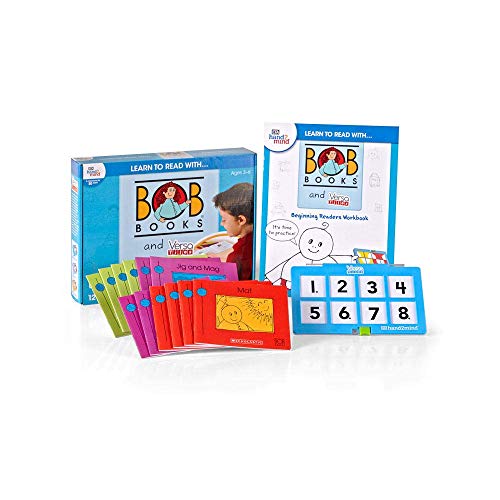
A child who knows letter sounds but has never finished a book alone is exactly who this set addresses. Twelve short Bob Books readers introduce sounds gradually, and the VersaTiles workbook with its self-checking answer case turns phonics practice into a tile-matching task the child controls. That combination matters because confidence, not difficulty, is usually the bottleneck at this stage. Finishing one whole small book gives a five-year-old evidence that reading is something they can already do.
Specs
- Brand: hand2mind
- Set name: Bob Books & VersaTiles Beginning Readers Set
- Included components: 12 Bob Books, 1 VersaTiles workbook, 1 VersaTiles self-checking answer case
- Workbook: 20 pages with 20 activities, according to the listing description
- Manufacturer minimum age: 36 months
- Manufacturer maximum age: 84 months
- Item model number: 90809
- Item dimensions: 12 x 9 x 2 inches
Best for: Building independent early reading with self-checking phonics practice.
Watch out for: The listing age starts at 36 months, but the reading step suits children who already know letter sounds; check the grade level of PreK-1 on the listing matches your child.
ASIN: B07HM7P73R
Learning Resources MathLink Cubes Kindergarten Math Activity Set: Sea Adventures!

This set pairs 100 linking cubes with structured tasks, which is what separates it from a plain tub of cubes. Fifteen double-sided write-and-wipe cards set out 30 activities covering addition, subtraction, sequencing and patterning, so a parent does not need to design the lesson. The ocean theme gives builds a purpose beyond sums, letting a child construct sea creatures from the same cubes used for counting. Because the cubes work with other MathLink Cubes sets, the collection can grow later.
Specs
- Brand: Learning Resources
- Manufacturer minimum age: 60 months
- Manufacturer maximum age: 120 months
- Included components: 15 double-sided write-and-wipe activity cards, 100 MathLink Cubes
- Total pieces in title: 115 pieces
- Cubes: 100 in 10 ocean-themed colours, according to the listing
- Item model number: LER9333
- Item dimensions: 8.78 x 2 x 8.94 inches
- Material: Plastic
- Batteries: No batteries required
Best for: Making addition and subtraction visible for a kindergarten child.
Watch out for: The manufacturer minimum age is 60 months, so keep the small cubes away from younger children, and have a wipe-clean marker available since the cards are write-and-wipe.
ASIN: B09SVMRJ6K
Learning Resources Math Scramble Game
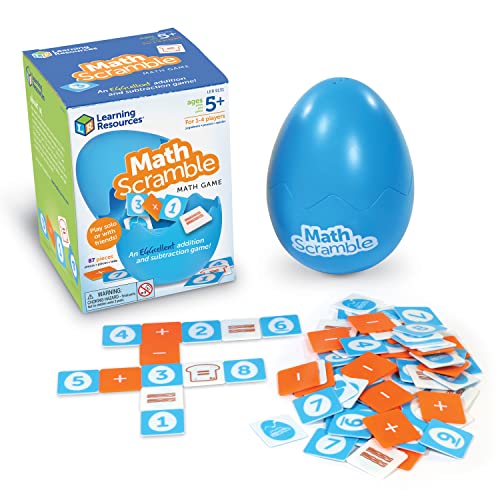
Where the cubes teach how numbers work, Math Scramble rehearses using them quickly, inside a game format. Players build and solve addition and subtraction problems with plastic tiles that store inside the set’s reusable plastic egg, which keeps the whole activity portable and quick to set out. It can be played alone or with up to three others, so it works both as quiet practice and as a family contest. That flexibility makes it a sensible second maths purchase after a manipulative set.
Specs
- Brand: Learning Resources
- Title piece count: 87 pieces
- Contents in listing description: 85 plastic addition and subtraction tiles, plus instruction guide
- Manufacturer recommended age: 5 to 10 years
- Item model number: LER9131
- Product dimensions: 4.25 x 4.25 x 5.65 inches
- Item weight: 8 ounces
- Players: Playable alone or with up to 3 others, according to the listing
Best for: Turning addition and subtraction facts into a repeatable game.
Watch out for: Tiles are small parts, so tip them back into the egg after play; a child who cannot yet add within ten will need the easier problems selected first.
ASIN: B097F2F738
Peaceable Kingdom Race to the Treasure!
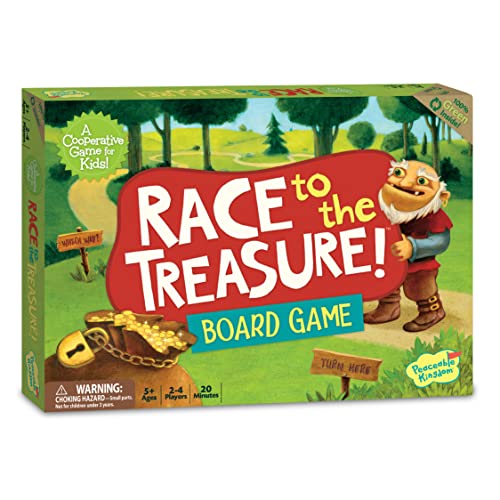
This cooperative path-building game removes the winner-versus-loser problem from a first board game. Two to four players work together to build a path and reach the treasure before the ogre does, taking turns, rolling and discussing which route to build next. No reading is required in the description of play, so a five-year-old who is not yet reading can still make real decisions. Finishing together also prompts the kind of planning talk that teachers value: what happens if we place this piece here?
Specs
- Brand: Peaceable Kingdom
- Manufacturer recommended age: 5 years and up
- Manufacturer minimum age: 60 months
- Number of players: 2 to 4
- Item model number: 49554PK
- Model name: Race to the Treasure
- Game type on listing: Cooperative path building game
- Reading: No reading required, according to the listing description
Best for: A first board game with real turns but a shared win or loss.
Watch out for: Confirm the included components on the listing before buying, since editions can differ, and keep game cards and tokens together so the path can be completed.
ASIN: B006S9MUPU
Thames & Kosmos Kids First Science Kit

For a child who constantly asks what happens if you mix things, this introductory chemistry set channels that impulse into twelve guided experiments. A 28-page full-colour manual walks through activities involving surface tension, solutions, mixtures, density and buoyancy, using a plastic lab station and durable tools rather than improvised kitchen equipment. Making a small figure in the first experiment gives the child a character to follow through the rest. Adult involvement is part of the design, so treat it as shared time, not solo play.
Specs
- Brand: Thames & Kosmos
- Manufacturer minimum age: 60 months
- Manufacturer maximum age: 120 months
- Item model number: 567022
- Experiments: 12, with a 28-page full-colour manual
- Included components: 2 test tubes with lids, 2 pipettes, 4 packets of blue alginate powder, dye tablets, plastic lab station parts, spatula, tweezers, stickers
- Title detail: 20+ durable tools
- Safety warning on listing: Not suitable for children under 3 years; choking hazard, small parts may be swallowed or inhaled
Best for: A first supervised experiment kit with proper lab tools.
Watch out for: Follow the manual and the listing warning exactly, supervise every experiment, and note that the alginate powder packets and dye tablets are consumables that will eventually be used up.
ASIN: B0DSCJFN67
Which One Fits Your Situation
Reading is the priority before first grade
Choose the Bob Books and VersaTiles set, because it attacks the exact bottleneck: sounding out short words and checking answers independently. Read one small book together, then let the workbook case provide the solo practice. Add nothing else until finishing a book feels ordinary, because that sense of completion is what turns a hesitant child into a willing reader.
Maths makes sense only when it can be touched
Go with the MathLink Cubes Sea Adventures set if written sums currently mean little to your child. Build each problem, count the joined cubes, then break the tower apart to subtract. Once that process feels easy and even boring, Math Scramble is the natural next step, converting the same understanding into quicker tile-based problem solving during a game.
Family game night needs a calmer first entry
Race to the Treasure fits households where competitive games end in tears, because everyone succeeds or fails together against the ogre. Turns, dice and shared decisions still get practised on every round. Start with two players to keep turns frequent, then invite more players once waiting patiently through a full round feels manageable for your five-year-old.
A curious child needs answers, not another worksheet
Pick the Kids First Science Kit when questions about bubbles, floating and mixing dominate the day. Twelve experiments with real tools give those questions a safe, structured outlet, and the manual explains the idea behind each result in simple terms. Plan one experiment per sitting, with an adult present, and let the child predict the outcome before starting.
Common Mistakes
- Skipping decodable books for harder story books, which teaches guessing from pictures instead of reading words.
- Buying maths toys with too few pieces, so problems beyond ten cannot be built or checked.
- Starting with a competitive board game when a child has not yet practised waiting through turns.
- Treating an experiment kit as an unsupervised toy, despite the listing warning and small parts.
- Buying several similar sets at once instead of one reading, one maths and one game option.
Frequently Asked Questions
What should a five-year-old be able to do before first grade?
Schools generally hope for letter-sound knowledge, counting with understanding, listening through a short group activity and managing turns with other children. No single toy covers all of that, which is why this list pairs a reading set with cubes, a game and a science kit. Aim for steady progress in each area rather than perfection in one, and talk to the school if progress stalls.
Are linking cubes better than counting on fingers?
Fingers remain a fine early strategy, but cubes add something fingers cannot: a joined group that stays visible while a child thinks. The MathLink Cubes set also brings activity cards, so problems arrive in a sensible order. Use both approaches together at first. Over time, the physical grouping helps a child picture numbers breaking into parts, which supports mental arithmetic later in school.
Why choose a cooperative board game over a competitive one?
At five, the learning target is the structure of play itself: rolling, moving, waiting and following a shared rule set. A cooperative game such as Race to the Treasure teaches all of that without making a parent the person who beat the child. Competition can come later, once losing a short game no longer ruins the evening. Many families find cooperative games also get requested more often.
How much adult help do these picks need?
Reading and maths sets are designed for short bursts of adult guidance followed by independent practice, especially where self-checking answers or activity cards are included. The science kit is different: its experiments need an adult present throughout, following the manual. Plan accordingly, giving the kit a weekend slot rather than leaving it in a toy box for unsupervised weekday play.
Related guides
More from Amazon
Programs that pair well with the guide above. Offers and eligibility are set by Amazon and may change.
Free shipping on eligible items, Prime Video and more. Eligible new members can start with a free trial.
Start a Prime free trialAd-free music streaming. Eligible new subscribers can start with a free trial.
Try Music Unlimited freeA Prime membership for ages 18-24 with a trial period. Eligibility is set by Amazon.
See Prime for Young AdultsAudiobooks and podcasts to listen to on the go. Eligible new members can start with a free trial.
Try Audible freeAs an Amazon Associate we earn from qualifying purchases.





Write Your Review
No reviews yet. Be the first to share your experience!