
Key takeaways
- Find the best women's running sneakers with arch support for daily miles, long runs and tired arches — cushioned, stable picks compared side by side.
What's inside
As an Amazon Associate I earn from qualifying purchases. This post may contain affiliate links at no extra cost to you.
Finding the best women’s running sneakers with arch support starts with how your feet actually move.
A shoe that feels soft in the shop can still leave your arches aching by mile three if the midsole collapses, the heel counter is too flexible, or the shape fights your natural gait.
The right pair should cushion each landing, guide the foot smoothly from heel to toe, and hold the arch in a supported position without forcing it into an unnatural shape.
When you run, your foot strikes the ground, flattens slightly to absorb shock, and then stiffens to push off.
Trouble begins when the arch drops too far, too fast, or stays collapsed through push-off.
That pattern is common with low arches, and it can show up as aching along the inside of the foot, sore ankles, or knee ache after longer runs.
Runners with high arches face the opposite problem: the foot may not flatten enough, so shock travels upward and the outer edge takes more load than it should.
A good shoe gives the arch a stable platform, spreads pressure across the midfoot, and keeps the transition moving in a straight line.
Some shoes do this with a firm medial post or a guidance system inside the midsole.
Others use a broad base, raised sidewalls, or a contoured footbed.
How to Choose
1. Match the Support to Your Arch Type and Gait
Arch support comes from the midsole shape, the foam density, the heel counter, and how the shoe guides your foot through each stride.
Runners with low arches who roll inward, known as overpronation, usually do best in a stability shoe, which adds firmer foam or guidance on the inside of the midsole to slow that roll.
Runners with neutral arches often do well in a neutral cushioned shoe, provided the midsole holds its shape and the arch area is not too soft.
Runners with high arches need cushioning first, because their feet absorb less shock, plus a contoured footbed that fills the space under the arch.
2. Cushioning and Energy Return
Cushioning softens each landing, and energy return helps the shoe spring back as you push off.
Softer foams feel plush and suit easy runs and recovery days.
Firmer, more responsive foams feel livelier and suit tempo runs and longer sessions.
For arch support, the quality of the cushioning matters as much as the quantity.
A thick slab of very soft foam can feel wonderful standing still, then collapse under the arch once you start running.
Look for cushioning described as structured, stable, or guided, rather than simply soft.
A broad midsole platform spreads load over a wider area, and a contoured sockliner adds support under the arch without a hard lump.
3. Heel-to-Toe Drop
Heel-to-toe drop is the difference in height between the heel and the forefoot, measured in millimetres.
A higher drop, around ten to twelve millimetres, suits runners who land on their heels, runners with tight calves, and runners who like clear cushioning under the heel.
A lower drop, around five to eight millimetres, brings the foot closer to level, encourages a midfoot landing, and can feel more natural for runners who land toward the front of the foot.
Drop also affects how the arch is loaded.
A higher drop can reduce strain on the Achilles tendon and calf, but it can shift more load toward the forefoot.
4. Breathability and Upper Fit
A running shoe upper should hold your foot securely without squeezing it, and it should let heat and moisture escape.
Engineered mesh is the most common choice for road running, because it can be more open where the foot needs airflow and more structured where it needs hold.
Look for mesh that feels flexible over the forefoot, so your toes can spread, and firmer around the heel and midfoot, so the foot does not slide.
Fit matters for arch support too.
If the shoe is too wide in the midfoot, the arch will not sit on the supportive part of the midsole.
If it is too narrow, the arch will be squeezed.
5. Stability Features That Actually Help the Arch
Stability features come in several forms.
A medial post is a firmer wedge of foam on the inside of the midsole that resists inward rolling.
A guidance system uses foam densities, a shaped midsole, and sometimes a firmer frame to steer the foot through a balanced stride.
A broad base and raised sidewalls work more gently, giving the foot a wider platform and a cradle that keeps it centred.
A firm heel counter, the structured cup at the back, keeps the heel aligned, which helps the arch stay supported.
None of these works in isolation.
6. Weight, Outsole Grip, and Durability
A lighter shoe feels faster and less tiring, but weight is not the whole story.
A very light shoe that lacks structure can leave the arch unsupported, while a slightly heavier shoe with a well-designed midsole can feel easier because it guides the foot efficiently.
For daily training, most road shoes strike a good balance, and the shoes below sit in that range for women’s sizes.
The outsole should grip wet roads and painted surfaces without adding unnecessary bulk.
Look for rubber in high-wear areas, such as the heel and forefoot, and a tread pattern that channels water away.
Durability matters because arch support fades as the midsole compresses.
Top Picks
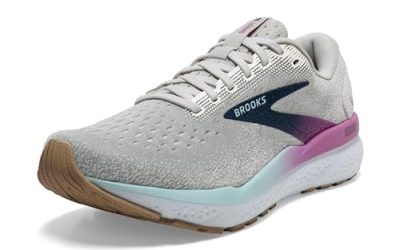
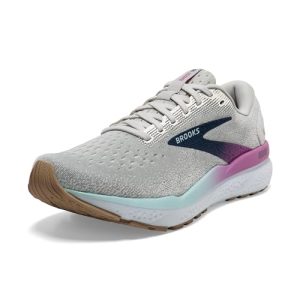
Brooks Ghost 16 Neutral Running Shoe

The Brooks Ghost 16 is a neutral daily trainer built around soft, structured cushioning and a smooth heel-to-toe transition. Its DNA LOFT v2 midsole gives a plush landing without feeling loose, and the segmented crash pad under the heel helps each step roll forward in a controlled way. The engineered mesh upper adapts to the foot, with a secure fit around the midfoot and room for the toes to spread. The heel-to-toe drop is 12 mm, which suits heel strikers and runners who like clear cushioning under the heel. For arch support, the Ghost 16 works best for neutral arches, and for mildly low arches where cushioning comes first and gentle guidance second. The midsole holds its shape through the middle of the shoe, and the footbed shares pressure under the arch rather than leaving a hollow gap. The shoe is recognised by the American Podiatric Medical Association, reflecting its focus on foot comfort and support. It comes in a wide range of sizes and widths, so narrower or wider feet can find a fit that keeps the arch in place. Key specs include a rubber outsole for road grip, a nylon mesh upper for breathability, and a lace-up closure for adjusting the fit over the instep. It suits neutral-arched runners, heel strikers, and daily trainers who want soft cushioning with a stable, predictable ride. Points to note: it is a neutral shoe, so strong overpronation may need a stability model, and the 12 mm drop is a change if you currently run in a low-drop shoe.
ASICS Gel-Kayano 31 Running Shoe
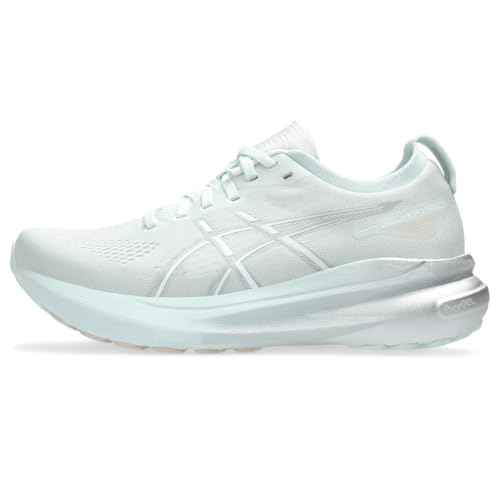
The ASICS Gel-Kayano 31 is a stability shoe for runners who want adaptive support and maximum cushioning on longer runs. Its 4D Guidance System combines foam densities and a shaped midsole to create a balanced stride, guiding the foot without forcing it into a rigid position. Rearfoot PureGEL cushioning softens landings, while FF BLAST PLUS ECO foam gives a light, responsive feel underfoot. The engineered mesh upper improves airflow, and the heel-to-toe drop is 10 mm. For arch support, this is one of the strongest options here for low arches or a tendency to roll inward. The guidance system works through the whole stride, so the arch is supported as the foot flattens and then stiffens for push-off. The external heel counter adds stability at the back, and the OrthoLite X-55 sockliner adds comfort under the foot. It is listed for road running and distance training, and its maximum cushioning suits runners who want protection over many miles. Key specs include a women’s-specific fit, a round-toe design, and a rubber outsole for road grip. It weighs around 266 grams in the listed size, reasonable for a maximum-cushion stability trainer, and it comes in multiple widths, including wide. It suits runners with low arches, overpronation, and distance trainers who want a stable, well-cushioned shoe. Points to note: it is a structured shoe, so runners who prefer a very light, minimal feel may find it built-up, and the fit is snug around the midfoot by design.
New Balance Fresh Foam X 1080v13 Running Shoe

The New Balance Fresh Foam X 1080v13 is a highly cushioned neutral trainer for daily training, long runs, and recovery days. Its Fresh Foam X midsole spreads foam across the wider parts of the shoe while keeping flexibility near the arch, giving a smooth ride without stiffness through the middle. The engineered mesh upper is breathable and flexible, and the shoe transitions smoothly from landing to toe-off, with a gentle rocker that helps the foot roll forward. For arch support, the 1080v13 suits neutral to high arches who need cushioning first. The midsole places more foam where the foot needs it most, and the shaped footbed helps fill the space under a higher arch, so shock is absorbed more evenly. Runners with low arches can use it for easy runs with a supportive insole, but it is not a dedicated stability shoe, so it adds no firm medial post. It is a good choice for one plush trainer for easy days and long, slow distance. Key specs include a Fresh Foam X midsole, a breathable mesh upper, and a rubber outsole for road use. It comes in multiple widths, including wide and extra-wide, helpful for more forefoot room without losing midfoot hold. It suits neutral and high-arched runners, long-run specialists, and recovery-day runners who want maximum cushioning and a forgiving ride. Points to note: it is a neutral shoe, so strong inward rolling needs a guided model, and the plush cushioning can feel soft at first.
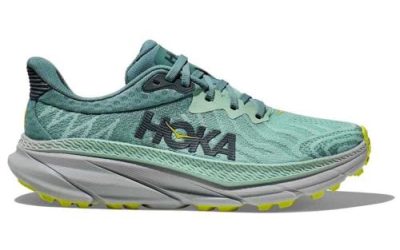
HOKA Clifton 9 Road Running Shoe

The HOKA Clifton 9 is a lightweight road shoe known for its thick, cushioned midsole and early-stage Meta-Rocker shape, which helps the foot roll forward with less effort. The compression-moulded EVA midsole gives a soft landing, while the engineered mesh upper keeps the shoe breathable on warm runs. It is built for road running, daily training, and walking, and it feels low-profile despite its thick sole, because the foam is light for its volume. For arch support, the Clifton 9 suits neutral arches who want cushioning and a smooth transition. The broad midsole platform gives the foot a wide base, spreading pressure across the midfoot, and the rocker shape reduces the work the arch does at push-off. The heel counter is structured enough to keep the heel aligned, and the fit is secure around the midfoot. Runners with high arches often like the Clifton 9 because the thick cushioning absorbs shock that their feet absorb less well on their own. Key specs include a lightweight EVA midsole, a breathable mesh upper, and a rubber outsole with grip in high-wear areas. It comes in women’s sizes and widths, including wide, and works well for daily miles without giving up cushioning. It suits neutral and high-arched runners who want a light, cushioned shoe with a smooth rolling feel. Points to note: the thick midsole gives a higher stack height, so it feels different from a low-profile trainer at first, and it is a neutral shoe, so firm medial support needs a stability model.
Brooks Adrenaline GTS 24 Supportive Running Shoe

The Brooks Adrenaline GTS 24 is a supportive shoe for runners who want cushioning and guidance in the same shoe. Its GuideRails system keeps excess movement in check, guiding the knees and feet into a more aligned position without a rigid post. The DNA LOFT v3 midsole gives soft, responsive cushioning, and the engineered air mesh upper improves breathability while holding the foot securely. The heel-to-toe drop is 12 mm, which suits heel strikers and runners who like a cushioned heel. For arch support, the Adrenaline GTS 24 is a strong choice for low arches and mild to moderate overpronation. The GuideRails system supports the arch indirectly by keeping the lower leg aligned, so the foot does not collapse inward as it flattens. The midsole is structured through the arch area, and the heel counter holds the heel in place. This makes it a good daily trainer for runners who tried neutral shoes and found their arches aching after longer runs. Key specs include a rubber outsole for road grip, a lace-up closure for an adjustable fit, and a women’s-specific last with a narrower heel. It is designed for road running, everyday training, and long runs, and it comes in multiple widths. It suits runners with low arches, overpronation, and daily trainers who want a supportive shoe that still feels cushioned and smooth. Points to note: GuideRails feels different from a traditional medial post, so give it a few runs, and the 12 mm drop is a change from a lower-drop shoe.
Comparison Table
| Shoe | Best for | Cushioning | Drop | Stability | Upper |
|---|---|---|---|---|---|
| Brooks Ghost 16 | Daily training, neutral arches | DNA LOFT v2, soft and structured | 12 mm | Neutral, crash pad | Mesh |
| ASICS Gel-Kayano 31 | Long runs, low arches | Maximum, PureGEL and FF BLAST PLUS ECO | 10 mm | 4D Guidance System | Mesh |
| New Balance 1080v13 | Long runs, recovery days | Plush Fresh Foam X | Mid-range rocker | Neutral, shaped midsole | Mesh |
| HOKA Clifton 9 | Daily miles, light cushioning | Light EVA, thick stack | Low to mid, Meta-Rocker | Neutral, broad platform | Mesh |
| Brooks Adrenaline GTS 24 | Daily training, overpronation | Soft DNA LOFT v3 | 12 mm | GuideRails support | Air mesh |
Which One Is Right for You?
Start with your arch type and gait, then match the shoe to your weekly mileage.
If you have low arches and your feet roll inward, start with the ASICS Gel-Kayano 31 or the Brooks Adrenaline GTS 24.
The Kayano gives maximum cushioning and a clear guidance system for long runs, while the Adrenaline gives a softer, more forgiving ride for daily training.
If you have neutral arches and want one shoe for most runs, the Brooks Ghost 16 is reliable, with soft cushioning, a smooth transition, and a higher drop for heel strikers.
If you have high arches and need shock absorption first, look at the New Balance Fresh Foam X 1080v13 or the HOKA Clifton 9, both with thick, even cushioning and a smooth roll.
Think about drop too: if you already run in a 10 to 12 mm drop shoe, staying in that range makes the change easier.
If you prefer a lower, more level feel, the Clifton 9 and the 1080v13 will feel closer to that.
Frequently Asked Questions
How do I know if I need arch support in a running shoe?
Look at your footprint, your old shoes, and how your feet feel after a run.
A full footprint with little inner curve, wear on the inside edge of old shoes, and aching along the inside of the foot after longer runs point toward more support.
Can a neutral running shoe give enough arch support?
Yes, for many runners with neutral arches.
A neutral shoe with a structured midsole, a contoured footbed, and a firm heel counter can support the arch well, especially if it holds its shape through the middle and does not collapse under load.
Runners with low arches and strong inward rolling usually need a stability shoe, because a neutral shoe will not slow the roll enough.
What heel-to-toe drop is best for arch support?
There is no single best drop for every runner.
A higher drop, around ten to twelve millimetres, can help heel strikers and runners with tight calves, and it places more cushioning under the heel.
A lower drop, around five to eight millimetres, can spread load more evenly and encourage a midfoot landing.
How often should I replace running shoes with arch support?
Replace them when the support fades, not just when the upper looks worn.
Signs include a midsole that feels compressed or flat, a heel counter that has softened, uneven wear on the outsole, or aching arches that did not ache when the shoes were new.
Many runners replace daily trainers after several hundred miles, but the exact point depends on your weight, gait, and surfaces.
Disclosure: As an Amazon Associate, we may earn from qualifying purchases.
Related guides
More from Amazon
Programs that pair well with the guide above. Offers and eligibility are set by Amazon and may change.
Free shipping on eligible items, Prime Video and more. Eligible new members can start with a free trial.
Start a Prime free trialAd-free music streaming. Eligible new subscribers can start with a free trial.
Try Music Unlimited freeA Prime membership for ages 18-24 with a trial period. Eligibility is set by Amazon.
See Prime for Young AdultsAudiobooks and podcasts to listen to on the go. Eligible new members can start with a free trial.
Try Audible freeAs an Amazon Associate we earn from qualifying purchases.
Write Your Review
No reviews yet. Be the first to share your experience!